
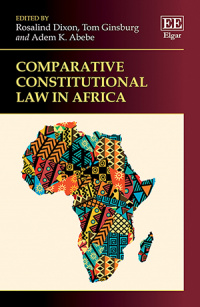
The title of this otherwise commendable book is slightly misleading. The title suggests that it deals with the field of “comparative constitutional law” in Africa, but in fact it is about the challenges that constitutionalism faces on that continent. Only one contributing author (Jan Erk) makes explicit reference to the nature, challenges, and attributes of constitutional comparison in the African context. It must be granted that the field bearing the (inherently imprecise) moniker “comparative constitutional law” remains largely undefined, but a reasonable assumption would be that it should involve methodologies for the comparison of the constitutional law of various jurisdictions. Comparison between selected jurisdictions is indeed undertaken by most of the contributors, which means that it would have made the title more accurate if “comparative” were replaced with “comparing”.
The value of the book is therefore not to be found primarily in an exposition of constitutional comparison in the African context, but in the discussion of broad themes (listed in the introductory chapter) relating to constitutional design, constitutional amendment and interpretation, transition to democracy, accountability, dealing with diversity, constitutional acknowledgement of values, rights and traditions, and some matters of supranational concern. Given the globally escalating challenges being raised against the tenets of liberal democracy, the global topicality of these themes in law and politics is certain. The focus of the book on the continent where the democratic ideals of constitutionalism arrived relatively recently may therefore serve as a magnifying glass trained on the manifestation of constitutional problems not only in Africa, but also in other parts of the world.
According to the norm for a collection of contributions such as this, the editors provide the reader in their introductory chapter with a competent and valuable oversight of the approaches and key arguments forwarded by the authors of each chapter. The chapter is commended to the prospective reader as a key to the substance of the book in its diversity. Here I will not duplicate the editorial synopsis, but merely make mention of salient elements that catch one’s eye in the rest of the book.
Abrak Saati, a political scientist from Sweden known for her work on participatory constitution writing (sometimes referring to the notion as “the participation myth”) places the four African examples she analysed comparatively more or less on a rising scale of effective public participation: in the making of the Nigerian constitution of 1999 mere lip-service was paid to public input; in Uganda many opportunities for participation were given between 1988 and 1995, but in the end the process was flawed due the exclusion of political parties and because a referendum was not held; despite often being hailed as a textbook example, in the South African process of 1995 and 1996 there is no evidence that the extensive volume of public submissions that were received actually affected the substance of the constitutional text, and Kenya (2009-2010) displayed some “outright undemocratic” elements of technocracy, some elements of representative democracy, and some of direct democracy.
The chapter on constitutional amendment relating to presidential term extensions in Africa, jointly authored by the editors, is essentially concerned with the binding force of constitutions in Africa. Neither “eternity clauses”, nor judicial opposition to unconstitutional amendments of constitutions have had a consistent record of success in the African countries reviewed by the authors, but a small measure of optimism may be gleaned from some instances, such as the reception in Kenya of the “basic structure doctrine” which originated in India.
Markus Böckenförde deals with the variety of approaches to judicial review and the mixed degrees of success achieved by judiciaries in Africa to curb executive ambition beyond the intentions of constitutional texts. The author’s capable analysis of the three case studies (Benin, Kenya, and Ethiopia) offers valuable comparative data and insights, and the chapter is provided with a comprehensive table summarizing the design of constitutional review in all African jurisdictions.
In his chapter, Charles Fombad exposes a key shortcoming in the constitutionalism of constitutionalised states (in Africa, but in reality also globally) namely the inability of the constitutional entrenchment of multipartyism to guarantee its survival. Despite noble intentions built into constitutional texts, the political instincts to entrench majoritarian domination and the neutralisation of minority politics often trump high constitutional sentiments. Close to the core of this phenomenon is the tendency in many African states to confuse party and state. In the “fledgling and faltering democracies” of Africa, the alternation of power is made unlikely by the stifling of meaningful political competition once one party succeeds in capturing the state.
Duncan Okubasu engages the phenomenon of African “constitutions without constitutionalism” which followed the apparent deepening of democracy on the continent after widespread constitution-writing and re-writing in the image of Western constitutionalism. He traces this trend back to the entrenchment of the “authoritarian norms and practices that developed under colonialism”.
The question how to deal with deep social cleavages in constitutional design is addressed by Assefa Fiseha. After describing the features of the constitutional design of Ethiopia, South Africa, Nigeria, and Kenya, he suggests a combination of accommodation and integration of cleavages. He notes that failed integration can deepen cleavages, thereby necessitating moving towards increased accommodation.
Hugh Corder highlights the enhanced role of courts empowered by recently written African constitutions to develop administrative law and justice. Despite the introduction to African constitutions of this element, the concomitant difficulties are captured by the author in the phrase “the regulation of public power through the law is struggling to be born”. He nevertheless takes courage from the indications that some progress has been recorded.
Corruption, the universal bane of politics, and particularly as an obstacle in the way of the growth of constitutionalism in Africa, is addressed by Selemani Kinyunyu. He describes ongoing efforts to combat corruption by constitutional means as well as with regional mechanisms. Again, national and regional judiciaries emerge as the most likely constitutional institutions holding out hopes for improvement.
The next four chapters deal with the protection of constitutional rights. Mugambi Laibuta’s chapter is concerned with incursions on freedom of expression in the digital environment in Africa with its more than half a billion internet users. He points out that, despite clear constitutional entrenchments of the relevant rights, effective remedies are insufficient in the countries whose records he covered, because government stratagems such as internet shutdowns and legislative limitations have regularly occurred. Litigation offers the best means of defence of these rights.
The constitutionalisation and realisation of socio-economic rights in Africa is Magnus Killander’s theme. He surveys a wide range of African constitutions in which mention of these rights has appeared since the early 1990’s and he provides a compact overview of some of the essential theoretical considerations regarding their nature, including questions related to the state’s obligation to provide resources to enable the realisation of the rights. Based on his analysis of key judgments in various African jurisdictions, he concludes that much remains to be done before it can be said that the constitutional rights concerned are being appropriately respected by governments.
In the veteran scholar (recently deceased) Johan van der Vyver’s chapter, the perennial tensions between law, religion and culture are highlighted with specific reference to customary African beliefs. The general tendency towards constitutional secularism (excepting a number of Islam states in Africa) is identified, with the South African constitution showing the most respect for religious self-determination. Van der Vyver distinguishes between the right to self-determination being a “collective group right” vested in individuals, and sphere sovereignty as in “institutional group right” that allows for resistance by religious institutions against external interference. The contribution ends with an emphasis on the international obligation of states to accommodate all spiritual values and practices in their jurisdictions, including where applicable traditional African religions.
Also regarding the notions of African pluralism and “collective group rights”, Jan Erk presents his impressive insights in indigenous African institutions. He deems such institutions to be capable of performing a “vital service . . . as non-governmental checks on political centralisation.” A large part of the chapter is suitably devoted to methodological considerations, which are particularly relevant to African constitutionalism. Erk reveals a marked distance between real and formal constitutions. Recognition of traditional cultural structures in Africa should, he finds, allow for “breaks on absolutism of all kinds”.
In the last chapter of this collection Micha Wiebusch explores the influence of the African Union (AU) on its members in constitutional matters. The rather complex “constitutional agenda” of the AU is described against the background of sharply rising statistics in recent years of AU activities and sanctions imposed on its members. Wiebusch finds that the AU has not yet succeeded in formulating an unambiguous understanding of constitutionalism, both in the formal and substantive senses, because of the difficulties involved in dealing with “such an open-ended concept.” Nevertheless, he considers the “Africanisation” of constitution-building to have gained significant momentum.
One of the merits of a collection of contributions like this under a title that suggests – intentionally or otherwise – that a unitary conception of constitutional law exists on the African continent distinguishable from similarly unitary approaches on other continents, is precisely that the notion is (unintentionally?) negated. The given that “African constitutionalism” has no inherent consistency across the continent is richly demonstrated in the 400 pages of this book. The fact that constitutional consistency is not determined by cartography makes one wonder about the methodological profitability of practising constitutional comparison across such a vast geographical theatre.
The reader is well-served in this compilation of valuable and expertly interpreted information. Much thereof would be difficult to come by otherwise, but African “comparative constitutional law” it is not.
Posted by Francois Venter (Potchefstroom)
Suggested citation: F Venter, ‘Rosalind Dixon, Tom Ginsburg & Adem Kassie Abebe (eds) Comparative Constitutional Law in Africa (Edward Elgar Publishing, 2022)’, BACL blog, available at https://wp.me/p80U0W-1xJ.
 British Association of Comparative Law