
Introduction
Despite having a separate legal system and jurisdiction which has roots back to the medieval period, traditionally, Norway was highly impacted by discourses on legal developments taking place outside the realm. Cross-juridical discourses and exchanges had influenced the development of the Norwegian legal culture for centuries. The exchange of legal ideas and their adaptation to the local legal culture was particularly dependent on individual legal scholars and their networks. One of the most prominent figures in Norwegian academia promoting cross-juridical exchange and actively using his personal networks when formulating and testing new approaches to law was professor Frede Castberg. From the outset, his work was based on comprehensive comparative studies and facilitated by his language skills that enabled him to study foreign and international law as well as get in touch and establish lifelong relations with prominent lawyers from other jurisdictions. In contrast to most of his Norwegian colleagues, his approach to law, which was strongly influenced by his international network and his experience abroad, was based on intersubjective categories downplaying but not entirely disregarding the legal pragmatism and realism prevailing in the domestic and Nordic discourse of the Interwar period.
Castberg’s Background and Academic Career
Frede Castberg, born on 4 July 1893, was the son of the renowned judge and politician Johan Castberg (1862-1926). Following his outstanding academic achievements (examen atrium – roughly equivalent to a Master of Arts – 1911 and juridicum – roughly equivalent to a Bachelor’s Degree – 1914), an internship at a local court, two sojourns in France and England, and later in Germany (1919) and Austria (1921), he emerged as one of Norway’s leading legal scholars during and after the Interwar period. Over the span of 35 years at the Faculty of Law at the University in Oslo, he made considerable contributions to constitutional law, administrative law, international law, and legal philosophy. Furthermore, he played a pivotal role in advocating for the recognition of political science as a distinct academic discipline. He held several positions at the ministry for foreign affairs. His most prominent administrative roles at the university were Dean of the Law Faculty and Rector of the University. He held the latter position for two consecutive terms.

International Relations and the Recognition of His Work
The merit of his work was internationally recognised, too. In the Festschrift for his 70th birthday, the tabula congratulatoria encompassed 377 (Norway), 59 (Denmark), 29 (Finland), 23 (Iceland), 60 (Sweden), 43 (outside the Nordics) names and institutions, including His Majesty the King of Norway, the President of Iceland and prominent legal scholars, such as Hans Kelsen, Alf Ross, Lord McNair and John Henry Merrryman, as well as leading Scandinavian scholars, such as Fr. Vinding Kruse, Thorstein Eckhoff, Bo Palmgren and Jan Hellner (See Castberg, F. (1963), pp. I-XIII). He received several academic awards and honorary doctorates (from the Universities of Paris, Uppsala, Helsinki and Minnesota). After the Second World War, he chaired the Academy of International Law in Den Haag (Netherlands) and from 1952 to 1962 he was member of the European Commission on Human Rights. At the time, he published extensively, including in English and French (for a complete list of his publications see: Kaare Haukaas: Frede Castbergs forfatterskap, in Castberg (1963), pp. 601-624 including 403 titles and publications, until 1963). The publications that saw the light of day between 1963 and 1977 when Castberg died are not systematised, but a search in the national archive service (Riksarkiv and the National Library) provides 32 titles). This article will mainly focus on his accomplishments and contributions to international and comparative law and legal scholarship as well as discussions on legal methodology in the Interwar period.
Castberg’s Moderate Constructivist Approach
Already in his doctoral thesis on the constitutional prohibition against enacting retroactive statutes (Grunnlovens forbud mot å gi lover tilbakevirkende kraft, 1919), Castberg showed a remarkable talent for legal analysis and a deep-rooted admiration for democratic institutions and constitutional values such as the rule of law principle (rettsstatsprinsipp). Nevertheless, the commission evaluating his thesis criticised Castberg’s constructivist approach to law. This approach was regarded as opposing the prevailing legal philosophical theory of law in Scandinavia at that time. Legal realism had become popular in particular through the works of Alf Ross in Denmark, and Axel Hägerstrøm and others in Sweden (See Pihlajamäki 2004, pp. 469-487).
Castberg himself defended his methodological approach in an article published in the Scandinavian Journal of Legal Science (Tidsskrift for Retsvidenskap) in 1922. He defined the constructive method as “the method in legal theory whereby one attempts to embody the norms of positive law in general rules in order to perceive the logical connection in the legal order, to spare memory from retaining innumerable detailed norms and – as is held by many – to enable the solution of future legal issues by means of the general principles arrived at.” Castberg defended the constructivist method despite heavy and, in his view, legitimate criticism aimed against the so-called Begriffsjurisprudenz. This Jurisprudence of concepts was regarded as a legal scientific approach completely detached from reality, society, and politics. Critics attacked, in particular, the deduction from abstract concepts without any positive anchorage and disregarding the consequences of the application of these legal principles in society (see, Mossberger 2022, pp. 289-355). Discussing and acknowledging the merits of arguments put forward by scholars criticising this approach, Castberg argued that it would have been a fatal misunderstanding to regard the constructivist method as redundant (Castberg 1922, p. 303; 1935, p. 55). This method could help to intellectually structure the law and to recognise its legitimacy.
At its core, Castbergs’s early method built a bridge between methodological positions of constructivism and realism by acknowledging the importance of both deduction and induction in identifying general principles which could consistently be applied to consubstantial cases which required equal legal treatment (Castberg 1922, p. 305). On the one hand, he argued, respect for the legislator’s choice could force us to accept results that seem unjust considering the specific circumstances of the individual case (ibid, p. 311). On the other hand, we needed to consider the practical consequences of deduction from scientifically constructed general norms to avoid unjust results based on pure logical reasoning.
Works on International Law and Constitutional Law
Already early in his career, Castberg developed a distinct interest in international law. Working for the ministry for foreign affairs, he applied for a professorship in 1927. The nomination board scrutinised Castberg’s suitability for the advertised role. They questioned Castberg’s qualifications for the role because of his interest in international law and his extensive publications in the field. Some members of the committee argued that Castberg’s publications on topics of international and comparative law would not qualify him as a professor of Norwegian constitutional and public law. This nomination process triggered a general debate on the classification of international and comparative law among scholars at the Faculty of Law in Oslo, which was the only law school in the country at the time. Castberg’s subsequent shift towards Norwegian administrative law can be regarded as a response to these allegations.
His comprehensive studies on constitutional law laid the groundwork for the establishment of public law as a distinct field of law. Already in 1918, he published an article in the Scandinavian Journal of Legal Science (Tidsskrift for Rettsvitenskap) on the principle of separation of powers and its role in French and Norwegian constitutional law. In this article, he asserted that parliamentary practice and the general attitude to law in society had led to a legal transformation of Norway’s constitutional structure (Castberg 1918, pp. 243-296). Based on this change in constitutional customary law, he argued that the government must resign when it faces a vote of no confidence. This would follow from the fundamental principle of parliamentarism which should be considered as an integral part of the current constitutional order in Norway (ibid, pp. 243-296; Andenæs 1997, p. 295). Uncontroversial today, and even codified (cf. Norwegian Constitution – Grunnlov § 15), this position was a radical standpoint at the time.
Constitutional Limits in the State of Emergency
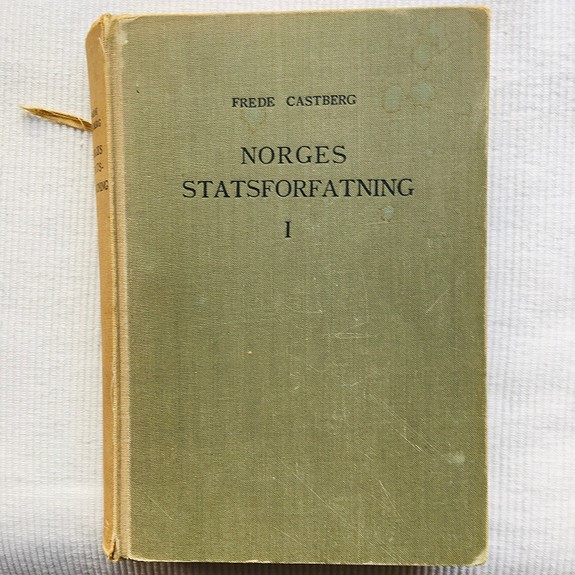
His carefully balanced approach allowed Castberg to include moral and political considerations in his legal philosophy and treatises on constitutional law. On this basis, he argued, inter alia, for the protection of minorities against a parliamentary majority or a constitutional right of resistance against tyrants. In his major work on the Norwegian constitution (Norges statsforfatning first ed. 1935), Castberg held that norms enacted by a regime based on suppression, terror, and violence and without ethical and moral support by the majority of the people are not binding law even if the constitutional procedures are followed.
Furthermore, he was the first one to discuss in detail the consequences of a state of emergency (unntakstilstand/konstitusjonell nødrett) in terms of constitutional competences and duties both for Norwegian state bodies and individual citizens (Castberg 1935, p. 23). After the Second World War, he became an advocate for the view that, given its exceptional and perilous consequences, a constitutional emergency should only be declared as a last resort.

Castberg and Kelsen
Concerning the structure and function of the constitutional order, Castberg constantly referred to Hans Kelsen’s idea of a hierarchy of norms (Stufenaufbau). Following Kelsen, for Castberg, there was, principally speaking, a difference between the method of solving doubtful questions of interpretation (which he regarded as the task of legal scholars) and the method judges or other legal practitioners use to solve specific cases. Analysing the latter was, according to Castberg, the task of social sciences or the science of psychology. A legal scientific method aims at providing general guidelines for systematically and logically coherent and, at the same time, substantively good solutions (See Castberg 1922, p. 305 ff.). This perspective rejects Kelsen’s moral nihilism but steers clear of legal realistic positivism. Hence Castberg advocated for a modified constructivist method which included elements of a sociological-teleological approach (1935, p. 57 ff.) but held clear limitations in the field of constitutional law. While it might be reasonable to build on a belief in the intuition of judges and to have confidence in the judge finding the “correct” or “best” solution in a given case, he warned that this approach might invite abuse. With reference to his prominent colleague, professor Francis Hagerup’s critique of legal pragmatism, Castberg objected against the method of the ‘Freie Rechtsschule’ (frirettsmetode) which allowed judges, under certain conditions, to set legislation aside. He maintained that this method had been widely rejected. Being true for the legal scientific community in Germany, this statement (at least to some extent) ignored the methodological positions of his Nordic colleagues pushing for legal pragmatism and legal realism.
Natural Law and International Law
Castberg’s take on natural law before the Second World War is also interesting. His standpoint can be characterised as ambivalent. Not sharing the reservation or refusal of the concept of natural law prevailing among Norwegian scholars in the late 19th and early 20th century, he acknowledged the value of a preexisting legal order from which principles of law could be derived (See Andenæs 1997, pp. 293-301). Such principles could guide lawyers in cases in which the positive law provided no clear solution. Building on Rudolf Stammler, Wendell Kretschmar, Hans Reichel and Oscar Platou, he accepted that all law is based on a distinct social ideal (Castberg 1922, p. 314). However, this ideal does not imply the existence of a universal and timeless legal order from which specific legal rules could be deduced (Castberg 1938, p. 13). He rather accepted that lawyers have a certain discretion on how to balance legitimate policy considerations, such as predictability or procedural, economic and societal consequences. Legal principles often encompass and operationalise policy considerations. Kjell Åke Modèer concludes in a recent article on Frede Castberg that “[d]ue to his support for natural law perspectives he also became an idealistic counterpoint in the strong positivistic legal culture of the Nordic countries …, characterized by Scandinavian legal realism and Kelsenian value neutrality within the law.” (Modèer 2021, p. 345).
The Role of Policy Considerations
Arguably, the most fundamental of these policy considerations is the perception of individual justice, which he calls ‘rettsfølelse’ or ‘rettsinstinkt’ (Castberg 1922, p. 314). To what extent he regarded this feeling or instinct (intuition) to be merely subjective or rather an intersubjective category remains unclear. Modéer argues Castberg abandoned his early “subjectivistic – and individualistic – idealism” after the Second World War and turned towards a more objective one close to the belief in human rights (Modéer 2021, p. 346). In the Interwar period (but to a certain degree still today) the quite homogeneous background and education of lawyers and judges distinguished Norway from other European legal cultures, in which the education and the background of judges was more diverse. In addition, the lack of a modern civil code in combination with a very small legal scholarly community made Norwegian legislation appear particularly fragmented. Against this backdrop, for Castberg, filling lacunas of positive law by balancing policy considerations seemed more appropriate than assuming that general principles of law or a rational natural law would always provide a specific solution. Consequently, according to Castberg, legal decision-making is an act of will (viljesakt) rather than an act of recognition (erkjennelsesvirksomhet) (Castberg 1922, p. 315). This view became prevailing and was not substantively challenged throughout the 20th century.
Castberg as a Comparativist
Already early in his career, Castberg enriched his legal dogmatic analysis with comparative observations (e.g. Castberg 1918, pp. 243-296 and 306-329). His main sources of inspiration were the Scandinavian neighbours, Denmark and Sweden (Castberg 1935, p. VIII). However, he followed closely the discussions in Germany, England, France and the United States. He was fluent in German, French, English and Latin, and he published in German and French. After 1938, he also published in English. Moreover, several references in his earlier treatises evidence a broader range of scholarly influences. Austin, Sabine, Kelsen, Gierke and Jellinek are frequently cited in his works. Most important for his works on Norwegian law was of course his dialogue with colleagues in the Nordic countries. In the Interwar period almost half of his scholarly publications were in the fields of international law and comparative law, including comparative constitutional law (See Haukaas, in Castberg 1963, pp. 602-611). After the Second World War, he published articles on Scandinavian legal philosophy and law inter alia in the renowned American Journal of Comparative Law (Castberg 1955, pp. 388–400).
Concluding Remarks
Frede Castberg was certainly among the most influential Norwegian lawyers of the Interwar period not just in Norway but in the Nordics in general despite the fact or perhaps because of the fact that he did not share the prevailing view on legal methodology or on the role of legal scholars with most of his colleagues.
Posted by Professor Dr. Sören Koch (Ph.D. Bergen), University of Bergen
This piece belongs to Season 2 of the “Cross-jurisdictional dialogues in the Interwar period” series dedicated to less-known legal transfers which have had a palpable impact on the advancement of the law. The Interwar period was a time of disillusionment with well-established paradigms and legislative models, but also a time of hope in which comparative dialogue and exchange of ideas between jurisdictions thrived. The series is edited by Prof Yseult Marique (Essex University) and Dr Radosveta Vassileva (Middlesex University). To access the other pieces from this series, either select the ‘Interwar Dialogue’ category or click on the #Series_Interwar_Dialogue tag on the BACL Blog.
Bibliography
Castberg, F. (1918). Nogen Ord om Magtfordelingsprincippet og dets Stilling i fransk og norsk Statsret. Tidsskrift for Retsvidenskap, 243–296.
Castberg, F. (1919). Grunnlovens forbud mot å gi lover tilbakevirkende kraft [Doctorial dissertation, University of Oslo].
Castberg, F. (1922). Den konstruktive metode. Tidsskrift for Retsvidenskab. 294-317.
Castberg, F. (1935). Norges statsforfatning. Vol 1, 1. Ed. Universitetsforlaget.
Castberg, F. (1955). Philosophy of Law in the Scandinavian Countries. The American Journal of Comparative Law, 4(3), 388–400.
Castberg, F. (1963). Festskrift til Frede Castberg i anledning av hans 70 årsdag 4. juli 1963. Oslo: Universitetsforlaget.
Pihlajamaki, H. (2004). Against Metaphysics in Law: The Historical Background of American and Scandinavian Legal Realism Compared. The American Journal of Comparative Law, 52(2), 469–487.
Mossberg O. (2022). Den konstruktiva riktningen och «begreppsjurisprudensen». Tidsskrift for Rettsvitenskap, 135(2-3), 289-355.
Andenæs, J. (1997). Frede Castberg. Lov og Rett, 36 (5), 293-301.
Modéer, K. Å (2021). Frede Castberg (1893–1977). In Helle Vogt and K. Å. Modéer (eds),Law and The Christian Tradition in Scandinavia, Routledge. 345–356.
Suggested citation: S Koch, ‘Frede Castberg (1893–1977): A Call for Moderate Constructivism in Nordic and International Law’, BACL Blog, available https://british-association-comparative-law.org/2024/06/21/frede-castberg-1893-1977-a-call-for-moderate-constructivism-in-nordic-and-international-law-by-soren-koch/
 British Association of Comparative Law