
The thing about comparative law is that it is not law. Comparative law is not like, say, contract or tort law—i.e. a specific field of law with its own principles, rules, policies, terminology and so forth. Rather, comparative law is a way of doing legal research and disseminating legal knowledge. Rather than being an obstacle to its intellectual development, this feature of comparative law is what makes it intriguing and challenging as both an academic discipline and professional practice. For since comparative law’s official—or ‘mythical’ (G. Frankenberg Comparative Law as Critique, Cheltenham: Edward Elgar Publishing, 2016, 5)—inception as a field of study and practice at the International Congress of Comparative Law, held in Paris in 1900, comparative lawyers have never stopped inquiring about their discipline’s aims, scope, benefits, perils, and methods. The high number of introductory texts to the field that have appeared in the last decade or so in English alone is indicative of the perceived need for continuously engaging with these matters.
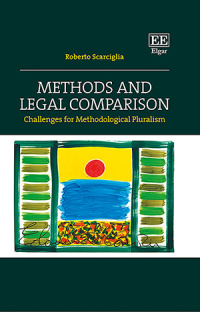
The very fact that there is no shortage of introductions to comparative law might prompt one to wonder whether there was a need for yet another such book. After having read Roberto Scarciglia’s new work on the topic, Methods and Legal Comparison: Challenges for Methodological Pluralism (hereinafter, ‘MLC’), the answer is a resounding ‘yes’. For Scarciglia’s new book is characterised by a blend of unique features that easily sets it aside from other accounts of the comparative enterprise. To begin with, it is worth noting that MLC is the English translation, with adjustments, of Scarciglia’s acclaimed Italian work, Metodi e Comparazione Giuridica, published by CEDAM in 2021. The book has also been translated into Spanish—a further testament to its international relevance. As the title suggests, MLC’s main aim is to provide readers – specifically, ‘law students’ (vii) – with ‘a basic introduction to comparative methodology and a tool for legal research’ (ibid.). The ‘belief’ animating Scarciglia’s account is ‘that knowledge of methodology is necessary in legal training and, notably, for research scholars who choose, for whatever reasons, to enter the boundless sea of comparison of different legal systems, or parts of them’ (ibid.). As the author aptly notes, however, to meaningfully present his views and the findings of his decades-long research and teaching on the subject to English-speaking readers requires more than merely translating the original Italian work. For if there is one thing that comparative law teaches us, is that context matters and that, accordingly, legal, socio-political, etc. cultures neither can nor should be disregarded. Accordingly, not only MLC features a new preface but also, the Introduction carefully takes the reader through the challenges and corresponding adjustments that have informed its making.
The book is divided into five thematic chapters, namely: ‘A Short History of Comparative Law’, ‘Comparative law Teaching: Objects and Aims’, ‘Methods and Legal Comparison’; ‘Comparison between Global Phenomena and Legal Traditions’, ‘Epilogue: Challenges for Methodological Pluralism’. Each chapter provides a well-rounded account of the themes it discusses in a learned, yet accessible manner which will no doubt benefit all readers and particularly, undergraduate students and beginners. A book review is not meant to summarise the work it discusses. Nor a short review like the present one could present a detailed overview of the various topics, thinkers, schools of thought, methodological approaches, and legal cultures MLC surveys and engages with. Rather, I will limit to note the following points hoping that they will provide readers with helpful tools when navigating through MLC.
First, it ought to be noted that, as hinted above, Scarciglia sapiently manages to explore difficult themes in an engaging and easy-to-follow manner. This is no easy task—especially for someone, like a legal comparatist, whose intellectual labour faces the challenge of transcending national cultures, sensitivities, and modes of thought. Secondly, a key feature of MLC is that it is not a merely descriptive account of comparative law’s nature, aims, history, and present and future challenges. Rather, each chapter provides readers with some critical inputs drawn from Scarciglia’s profound knowledge of the field. By way of an example, consider the author’s concluding remarks at the end of chapter one, which provides a brief historical account of legal comparison’s origins in the ancient world (origins which, for the most part, took the form of cultural influence over foreign regulatory phenomena and experiences: ibid., 5) and further development all the way down to present-day society. Reflecting on what his findings tell about comparative law’s journey to date, Scarciglia notes that ‘legal history does not represent the end goal of comparative inquiry. Nevertheless, the eye of a comparatist looks at a historical fact, beyond legal classical, with freedom, without prejudice, and regardless of whether it is a matter of autochthonous law of foreign law’ (ibid., 31). MLC is replete with such insightful remarks.
Of particular value is also section 5 of chapter one, titled ‘What is “Legal Comparison”?’ For the very fact that comparative law is a way of doing legal research makes it particularly difficult to define, in precise terms, what it aims to achieve as well as why and how. Scarciglia himself concedes that ‘a general definition of the term “comparative law” is almost impossible’ (ibid., 33). As a workable definition, he suggests Jaakko Husa’s: ‘“comparative law is a special field of legal study that is dynamic and open to innovation and is not cemented to any particular special research approach of the legal discipline’ (ibid.). Once transposed onto the social sciences field, this intellectual openness takes the form of a peculiar way of doing comparison that fits law as a regulatory phenomenon broadly understood. Thus, drawing from Giuseppe De Vergottini’s recent definition, Scarciglia sees legal comparison as ‘the intellectual operation of comparing law, institutions, and regulations of different legal systems, which, if carried out systematically according to the canons of legal method, takes the characteristic of a scientific discipline’ (ibid., 47). This simply means that while legal comparatists share some ‘common [methodological] traits’ (ibid.) independently of where they are based, of what legal culture they are exploring, and of what task they are pursuing, ‘some peculiarities distinguish comparison in the field of public law – administrative, constitutional, and criminal law – from that in private law, which may include, among others, civil, commercial, company, competition and labour law’ (ibid.). Comparative law, in short, cannot but adapt itself to the fact that law is a discipline specific subject. As to why one compares, Scarciglia acutely observes that legal comparison is meant to further the inquirer’s knowledge of the subjects of study. More particularly, ‘[k]knowledge of foreign legal systems enables the scholar to acquire cognitive elements through which broad research interests can be conveyed’ (ibid., 49).
Arguably, MLC’s most interesting chapter is chapter 3, on the nature of comparative legal methodology and the need for interdisciplinary in comparative legal studies. For as its title makes it clear, the chapter epitomises MLC’s analytical spirit and scholarly objectives. In it, the reader is presented with a wealth of views, data, findings, and insights on what legal comparison amounts to methodologically as well as why legal comparison proper cannot do without interdisciplinary collaborations. From micro- to macro-comparisons, from horizontal to vertical comparisons, from bilateral to multilateral comparisons, from functionalism to structural comparativism, from legal formants to quantitative and gender-sensitive comparative law, the chapter paints on the broadest of canvasses to show readers how rich, dynamic, and quintessentially interdisciplinary legal comparison is as both an intellectual discipline and professional practice.
Yet, this methodological ‘richness’ (ibid., 130) would be meaningless if it were not aided by a deep-level awareness regarding the pluralist ethos informing legal phenomena and normative experiences more broadly. That is, in a nutshell, MLC’s main message to its readers. Methodological pluralism is of little—if any—value if it is not implemented by the comparatist’s self-reflective openness towards the plurality and alterity of the world. ‘The plural event’, writes Andrew Benjamin, ‘is that which allows for singularities’ (Towards a Relational Ontology: Philosophy’s Other Possibility, New York (NY): SUNY Press, 2015, 3). Seen from the angle of comparative law, this means that any legal culture acquires its own identity and value only through the prism of other legal cultures. One can only thank Scarciglia for his masterful reminder of what makes legal comparison such a worthy enterprise.
Posted by Dr Luca Siliquini-Cinelli, School of Law and Politics, Cardiff University
 British Association of Comparative Law