
Introduction
Anyone who tries to get a hold of comparative law of today notices quickly that the field has diversified and expanded remarkably. Contemporary textbooks on comparative law’s theory and method demonstrate how the field changed over the last few decades. The old idea of one predominant method for comparative research has been all but abandoned. This change reflects general developments such as, for instance, globalisation and waning of the Westphalian legal thinking in international law. The scholarly shift is not only about the growing number of publications and legal scholars interested in comparative study of law. Changes have moulded the way comparative law is conceived. New influences and approaches are vividly discussed. Arguably, comparative law has evolved significantly in this century but there are colliding views about the field’s scope, methods, and outlook.
For the comparatist, the unavoidable question that comes up is what to think about all this and, primarily, how to steer one’s way through the thick jungle of scholarship? What will the future of the comparative study of law look like? Diversity of the field brings both opportunities and obstacles. On the one hand, those who study law comparatively have much freedom as there are several methodologies. On the other hand, there is such a rich choice of varying approaches and academic styles that it has become difficult for an aspiring scholar who wishes to study legal phenomena comparatively to choose their path.
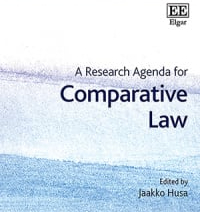
This situation explains why a book like A Research Agenda for Comparative Law (edited Jaakko Husa. Edward Elgar Publishing 2024, x+226 pages) makes sense even though there is no single agenda. The goal of the book is to spark the key questions and possible directions future comparative law research might take. The chapters are designed to serve as an inspiration for both established scholars and for future doctoral students around the globe. Importantly, the book reflects the present-day comparative law scholarship that embraces diversity and shuns away from a view that built on the idea of one-size-fits-all. As a part of the Elgar Research Agendas series, the book has but one purpose: to outline the future research in the comparative study of law by helping comparatists and other jurists interested in engaging with the field to make sense of the whole.
Main Content
Thomas Duve discusses comparative and global legal history and starts by noticing that legal historians who engage with comparative or global legal studies share similar problems as comparative law scholars. The context is the changes that internationalisation, digitisation, and increasing interdisciplinarity of legal scholarship have brought. In his view, these changes are both a challenge and an opportunity for the comparative study of law. The idea is to engage in a global conversation about law and its evolution over time, seen through something other than the Western paradigm(s).
Fernanda Pirie argues that understanding what is culturally specific cannot be achieved without some form of comparison. This is because describing social forms necessarily involves abstraction. This, in turn, calls for comparing and identifying similarities and differences. In short, comparison makes it possible to achieve a better understanding of a particular example leading to general theories and novel ways of thinking about the forms that laws take and their role in different societies. Importantly, she shows that applying an interpretive approach in the empirical study of law does not mean abandoning the search for commonality.
Ralf Michaels discusses coloniality by posing questions and then answering them. He explains how colonisation and colonialism have always been important objects of comparative law. Comparatists have explored indigenous laws and other normative systems in the colonies but decolonial comparative law goes beyond these boundaries. Decolonial comparative law builds on the assumption that colonisation created modernity and coloniality as two inseparable sides of the same medal. Importantly, if we are modern, then we are at the same time colonial. Modernity is thus defined in differentiation not only from the (premodern) past, but also from the (nonmodern) other that is the non-European world.
Geoffrey Samuel builds on the observation that legal education and comparative law are preoccupied with what it is to have legal knowledge in general. Legal education needs to place emphasis on legal epistemology. In turn, comparative law needs to have a view on what law is and what comparison is. Samuel shows that these questions demand sensitivity to epistemology and methodology over the borders of law as a discipline. Samuel points out that there are elemental challenges. One challenge he discusses is AI and the accompanying idea of ‘legal singularity’ (a kind of a robot judge). Samuel argues, in essence, that if legal scholars accept a view of law that is singular and unique, it means risking both the future of quality legal education and comparative law.
Jen Hendry proceeds from an assumption according to which the comparative study of law is more effective, informative, and influential when it draws from the various socio-legal approaches. In essence, her chapter is a manifesto for the inclusion of the socio-legal within the comparative study of law. She does not argue that the comparative study of law needs to be always more socio-legal however. The key takeaway is that comparative approaches are beneficial in the comparative study of law simply because the comparatist can apply and learn from the resources of socio-legal scholarship.
Michael Palmer argues that comparative legal studies are about embracing a broader approach to comparative study than is often found in much of the existing work in the field of comparative law. Essentially, he abandons the idea according to which the term ‘legal studies’ would somehow carry less status than that of ‘law’. Comparative legal studies, embracing interdisciplinary approaches, require giving more attention to the importance of empirical research and innovative thinking freed from a more traditional law-focused view.
Jan Engberg maintains that comparative law needs to take the role of language and legal knowledge seriously. This, in turn, is based on the fact that law and language are each other’s prerequisites. In short, the law needs to be expressed in language in order to exist in the social world. The discussion revolves around the idea that the comparatist and the translator need each other. Engberg argues for the triadic model where law, language, and knowledge are in an interactive relation with one other. The key idea is that one can compare relevantly what one has understood on the basis of the relevant body of knowledge. This requires cooperation between the translator and the comparatist.
Catalina Goanta focuses on technological change, and contends that cyberspace and comparative law are, in fact, distant relatives. She argues that comparative law themes are not only relevant, but even essential for the legal study of cyberspace. She discusses how comparative law can inspire the study of cyberspace. First, she explores the early nature of cyberspace law. Second, she addresses legal pluralism against the backdrop of cyberspace, focusing on the private governance legal frameworks introduced by online platforms and the proliferation of frameworks operating in parallel to each other and to State law. Third, she sheds light on the role of comparative law in cyberspace and proposes research directions based on settled comparative law directions.
Qiao Liu argues in favour of the geographical expansion of comparative law by taking Asian laws better into account. This chapter illuminates the importance of Chinese law to future comparative law studies. Instead of discussing methodologies, Liu highlights the continuity of certain key elements of the Chinese judicial tradition. The aim is to demonstrate through an historical account what the intellectual and legal-cultural background of the modern Chinese system of precedent is. He explains the core features of the Qing Dynasty precedents and links them to the present day. Instead of merely arguing for the importance of studying Chinese law, Liu demonstrates how a legal historical account is beneficial for anyone trying to study Chinese law comparatively.
Conclusion
In essence, the chapters embrace the plurality of the field and offer insights to consider for all kinds of comparatists who are interested in studying law comparatively. Instead of one research agenda, there are many. Nevertheless, there are certain commonalities too:
- First, there is no one-size-fits-all in the comparative study of law. Besides the traditional doctrinal or the so-called functional comparative law, one can draw from history, anthropology, socio-legal, decolonial, linguistic, or non-western bodies of knowledge and their accompanying methodologies. The shackles of the past scholarly mentality aiming to build one unified field of comparative law are, for the most part, shaken off as new future paths are becoming thinkable.
- Second, the comparative study of law means necessarily studying law in context. All the chapters make it clear that studying comparative law requires seeing law as a part of something larger that exceeds the limits of narrowly understood law. This means, in turn, that modern comparative law necessarily conceives law in a broad manner not only through the prism of the lawyerly mind but also through the prism of the historian, the anthropologist, the critical scholar, the legal educator, the socio-legal scholar or the linguist.
- Third, studying comparative law requires to be aware of its intellectual baggage. Many of the chapters struggle to break free from the paradigmatic ideas originating from past comparative law scholarship. The ideas that are criticised centre around the doctrinal study of law, Euro-American centrism, epistemic colonialism, and the overly narrow focus on law. The authors are aware of the past of the field and the arguments they put forward flow from their critical awareness of the past of the comparative study of law.
- Fourth, comparative law as a field needs to be – in one form or another – interdisciplinary as to its nature. The chapters highlight, in their own ways, that in order to study law comparatively in the future, one cannot rely solely on law as a discipline. Whichever directions the future of comparative law goes in, it needs to be more interdisciplinary than what has been the case so far.
Posted by Professor Jaakko Husa, University of Helsinki
 British Association of Comparative Law
1 Comment
Comments are closed.