
‘Intellego quid loquar’
Cicero, Pro Ligario, 15
Introduction
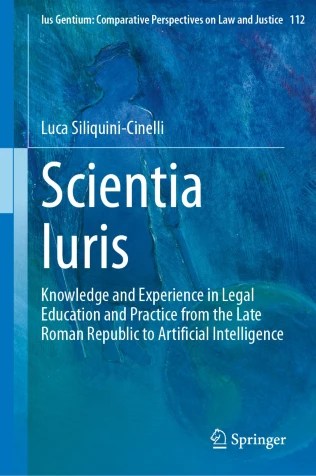
My new monograph, Scientia Iuris: Knowledge and Experience in Legal Education and Practice from the Late Roman Republic to Artificial Intelligence (Springer, 2024, Ius Gentium: Comparative Perspectives on Law and Justice, Vol. 112), aims to untangle what appears to be a paradox in Western and Western-oriented jurisdictions. The paradox is that while law, as a governing institution is thriving, the very places where future legal professionals are formed and those places where it is practised are undergoing a severe crisis. At first glance, the suffering of legal education and practice may seem incompatible with the expansion and intensification of law’s regulatory reach. Yet, the book argues, these two trends are not only compatible; they are part of the same phenomenon—namely, that law is and will always be more capable of regulating social relations without the experiential intermediation of legal experts (‘jurists’ in Civil law systems; ‘lawyers’ in Common law ones). This is because of law’s nature and operational dynamics as an intellectual artifact to be used for ordering purposes. For as a product of the intellect, law is a matter of knowledge, not experience. In fact, law’s artifactuality voids experience, including that of legal experts, making it redundant—or so the book argues.
To be sure, in the book I acknowledge that as in any human endeavour, experience does play an important role in the teaching, study and practising of law. Yet, I also show that law being an intellectual artifact, at some point experience is replaced by knowledge. This is the reason why, the book also shows, similarly to what occurs in metaphysical thinking, in law the epistemological and the ontological systematically overlap and mutually inform each other.
The book traces law’s existential fascination with knowledge from Roman times to date. It does so inter-disciplinarily and comparatively. Specifically, it draws from the work of Emanuele Severino, the greatest Italian philosopher of the past century, to argue, on philosophical grounds, that the epistemic ethos informing our legal consciousness can be traced back to the Promethean myth as narrated by Aeschylus. Further, the book contextualises the knowledge-driven categorisation of law it sets forth from both a Civil and Common law point of view, using legal education and practice as case studies. For, the book shows, in both Civil and Common law countries, despite the official emphasis on such notions as student experience, legal education and practice are intellectual activities that revolve around knowledge and analytical techniques of reasoning and argumentation.
Knowledge vs Experience
The key question, then, is ‘what is knowledge?’. In the book, I explain that knowledge is information—i.e. a metaphysical, sharable, and truth-independent end-result of intellectual processes of ontological abstraction that transcend experience’s facticity and finiteness. As such, it is altogether different from experience, despite knowledge requiring an ontic entity, or factical medium, to operate. For knowledge is impersonal and ethereal, whereas experience is subjective and immanent, i.e. it is bound to and inseparable from our own facticity. The fact that knowledge is but information explains why it is ‘non-rivalrous’ (Mokyr)—i.e. why it does not define the entity which attains and holds it, and by means of which it can be disposed. If it did, it would be inseparable from that entity. Instead, like a computer file that can be copied and pasted from one folder to another, knowledge can be shared without being altered and without the original knower losing any of it. On the contrary, the fact that experience is and cannot but be factical and finite explains why it is inseparable from the subject that undergoes it, as well as why it is experience, and not knowledge, that defines who we are as individuals.
The phrase at the centre of this book, ‘scientia iuris’, points to the cognitivist nature and dynamics of legal education and practice as intellectual activities, and the repercussions that law’s embeddedness with knowledge has on the ‘law-legal expert’ relationship. Once we understand that knowledge is information and thus has no natural relation to truth, we can depart from established narratives on law’s nature and working logic as both as an intellectual enterprise (specifically, on its scientificity) and as a phenomenon of social ordering. In particular, decoupling knowledge from truth enables one to appreciate that scientia iuris is not the exclusive remit of dogmatic analysis and argumentation (scientia iuris as doctrina iuris); rather, it denotes the knowledge of the law sought by all those who teach, study, and practise it (scientia iuris as cognitio iuris). Importantly, the type of knowledge that scientia iuris denotes is pursued through a form of thinking and argumentation that moves along reason’s metaphysical, constructivist lines and voids experience.
Key Takeaways
The are four key takeaways from the book. The first concerns the current crisis legal education and practice are undergoing, and their future outlook. It is that the fading of experience is the existential threshold where all the various forms which the crisis of legal education and practice manifests itself in meet. For if knowledge is impersonal, and if all that (the teaching, study, and practise of) law needs to perform its regulatory function is in fact knowledge, then we do not need the experiential figure of the jurist to act as an ontological medium between law and life. Nor we need (legal) education’s individualising (i.e. other-regarding) ethos. All that we need is a form of education that focuses on bare, constructivist learning—and, say, either let do the job by one-right answer problem-solving assessments, or computational, algorithm-based modes of legal reasoning and argument (as is gradually being done). Little wonder, then, that law students are increasingly incapable of thinking independently and critically, and increasingly engage less; or that law teachers increasingly do not know what to teach and how to teach it; or that graduates increasingly struggle to enter the professional world and if and when they do enter it, they lack the skills they require to successfully practice their discipline (to just mention some of the developments which signal the demise of legal education and practice, and which the book explores). To be sure, the problems that are affecting legal education and practice are but instances of a broader societal – if not anthropological – demise. Accordingly, any solution to them cannot come from within the higher education and professional dimensions only (the book discusses this in detail; see also below). However, in pursuing knowledge at the expense of experience, legal education and practice are, however paradoxical it may sound, the very activities which enable law to regulate social interaction without the aid of legal experts. This, in turn, explains why law, as a governing institution, is thriving, whilst the very places where future legal professionals are formed and those places where it is practised undergo a profound crisis.
The second takeaway has to do with the relationship between law and technology. The book argues that despite what is commonly and too easily held, the fact that law is and will always more be able to operate without the experiential aid of legal professionals is not due to the spread of technological means in the legal domain. For, the book also argues, the incursion of technology in the legal education and services fields (think of OpenAI’s GPT-4) is not the cause of law’s detachment from the legal expert; it is, rather, one of its consequences. If we are to fully comprehend what is occurring to the ‘law-legal expert’ relationship, we need to reach a deeper and more intricate level of analysis than the one where the ‘law and technology’ scholarship typically stops. What is required is an examination of law’s nature and working logic as an intellectual means for social ordering. Taking up this challenge, this book shows that the real reason why law’s regulatory function is increasingly severing itself from the experiential intermediation of legal experts is hidden in the very ways it has been taught, studied, and practised since the inception of juristic activities in the Late Roman Republic.
From a comparative law point of view, the book shows that epistemologically, the differences between the Civilian and Common law mind-sets and cultures are not as profound as is usually thought. For in both traditions, the teaching, study, and practise of law have always been dependent upon a form of thinking and language that is both structured and structuring along rational and cognitivist lines, of which logical and analogical forms of validation as well as conceptual representationalism are the protagonists. The book gives several examples to support this argument. In his endorsing remark of the book, Joshua Neoh affirmed: ‘If Luca Siliquini-Cinelli is right, then Oliver Wendell Holmes is wrong’. Engaging with Neoh’s remark in his book review for The Italian Review of International and Comparative Law, Pier Giuseppe Monateri commented on my findings and argument thus:
[Y]es, Holmes was wrong, especially from a comparative perspective. It is not true that there are systems, such as those of Roman law, that are more intellectual, and systems, such as the Common law, whose life is based on experience. Rather, legal systems intellectualize experience differently (although Siliquini-Cinelli also explains why and how Civil and Common law systems share some important elements, such as the need for logical and structured analysis and argumentation). Accordingly, the life of law is always knowledge and never a simple experience. From this viewpoint, the epistemology of comparative law is perhaps about understanding the different epistemologies of various legal systems. This implies a deep understanding of how different legal systems transform experience into knowledge through distinct intellectual paradigms.[1]
The final, yet primary, takeaway from the book is philosophical. It concerns the relationship between knowledge qua information, the way the intellect operates, and normativity. For in arguing for a new understanding of, and approach to, scientia iuris, the book also shows that the suffering of legal education and practice is not an isolated, or accidental, event. It is, rather, an instance of a broader phenomenon which, to use an expression of Ernst Cassirer, may be referred to as ‘the radical intellectualization of … life’. The intellectualisation of life is a normative phenomenon. It is normative because it is a meaning-seeking endeavour through which we turn experience into knowledge to understand and order the world. As we turn experience into knowledge, we equip ourselves to counter the anxieties and fears that the experience of immanency (i.e. the experience of our factical finitude) and a chaotic existence generate (‘chaos’ meaning, not incidentally, ‘abyss’ in Greek). ‘[T]he making sense relation’, David Owens has aptly observed, ‘is the basic normative relation’. What renders the making-sense relation the basic (i.e. primary) normative relation is, I suggest, the fact that, intellectually, we make our way through whatever we encounter in life by assigning intelligible meaning to it and ordering it accordingly. The intellect carries out this cognitive, meaning-assigning exercise by abstracting ontologically what we feel, perceive, and ‘are directly aware of’ (Hatfield) and turning it into information. In other words, through the making-sense relation, we produce information out of experiential data, and regulate our existence accordingly so that chaos and uncertainty are averted, our existential fears and anxieties managed, and ‘the rot of entropy’ (Pinker) resisted (to the extent that it is possible). The intellect’s cognitive constructivism is precisely what lies at the core of scientia iuris as the phrase is understood and used in the book.[2]
Now, as I also mentioned in a reply to a symposium on the book hosted by Amicus Curiae – The Journal of the Society for Advanced Legal Studies, one of the Western tradition’s existential canons is that intellectual and spiritual flourishing requires, and is inseparable from, the pursuit and attainment of knowledge. For as Dante put it, ‘mai non si sazia nostro intelletto’ (Divina Commedia, Paradiso, IV, 124-125).[3] Since at least Parmenides, knowledge has been equated with truth. Specifically, it is commonly believed that true (i.e. safe, certain, universally valid, incontrovertible—in a word, epistemic) knowledge (epistḗmē) is knowledge which is obtained through reason’s methodological effectuality. Conversely, knowledge which falls short of truth is mere dóxa—opinion, (untrue) belief, fake news; it has no meaning for it is, literally, non-sense. My book challenges this ‘truth-entailing’ (Fine) conceptualisation of knowledge. It shows that knowledge is, rather, the bare possession of that which ‘is intellectually known (ipsum intellectum)’ (Gilson) as a result of the intellect’s meaning-seeking endeavours—i.e. information. Accordingly, knowledge has no natural relation to truth; rather, any such relation is an artificial creation, if not an idealisation. Unhinging knowledge from truth enables one to appreciate what it actually means to know the law (i.e. how legal knowledge is attained, shared, altered, etc.) and thus, situate scientia iuris within its proper historical, philosophical, and comparative context.
Posted by Luca Siliquini-Cinelli, Reader in Law, School of Law and Politics, Cardiff University
[1] The book has also been reviewed in The Law Teacher.
[2] Relatedly, the primary role exerted by the principle of ‘legal certainty’ in Western legal consciousness is but a consequence of the normative, ordering ethos underpinning the intellect’s making-sense efforts.
[3] ‘Never is our intellect satisfied’. My translation.
 British Association of Comparative Law