
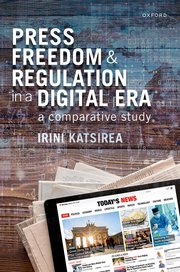
Press Freedom and Regulation in a Digital Era: A Comparative Study aims to explore the changed environment in which the press operates and the regulatory challenges it faces in the digital era. The title alludes to the inherent contradiction between the traditional understanding of press freedom as freedom from licensing and censorship and a new-found impetus for press regulation. The spectre of state regulation has time and again served to admonish the press for its transgressions and to push for effective self-regulation. This book is not concerned with the merits and demerits of press self-regulation, but with the challenges to press freedom as a result of the digitalisation of the press product. The phrase ‘regulatory turn’ has been coined to describe the flurry of legislative activity and policy initiatives to render the internet more accountable against the backdrop of a heightened concern about the online circulation of harmful content (P. Schlesinger, ‘After the post-public sphere’ (2020) 42 (7-8) Media, Culture & Society 1545, 1549ff). This monograph argues that this nascent ‘regulatory turn’ has already spilled over and left its imprint on the regulatory framework for the digital press.
The inspiration for this book
Much of the inspiration for this book came from de Sola Pool’s seminal work from the early eighties in which he warned that the printed press might be subjected to government regulation much like the broadcast media once they came to share the same technologies of transmission. As a token of proof, he quoted the Federal Communication Commission (FCC) chairman’s question ‘whether a newspaper delivered by teletext is an extension of print and thus as free as any other newspaper, or whether it is a broadcast and thus under the control of the government. (I. de Sola Pool, Technologies of Freedom (Harvard University Press 1983) 1). The delineation between the print and broadcast domains still informs much of the official thinking about the regulation of the online communication environment. Traditionally, the print media have been left largely unregulated while the broadcast media have been subjected to extensive regulation in the public interest. The dichotomy between these regulatory paradigms permeates the evolving policies for the digital media at a critical stage for their development.
A comparative methodology
This monograph seeks to chart the direction of travel for the digital press by embracing a comparative methodology. It is comparative in three respects, which will be discussed in turn. First, it seeks to shed further light on the regulation of the press in the digital era and on the impact of the proliferating media laws, policies, and jurisprudence on press freedom through a comparative lens. Such an approach befits media law, a discipline that knows no borders. However, application of a comparative methodology is hitherto underrepresented in media law, especially as regards the study of press compared to broadcasting regulation (For some examples of comparative media law and policy research, see P. Wragg, A free and regulated press: defending coercive independent press regulation (Hart 2020); L. Fielden, ‘Regulating the press. A comparative study of international press councils’ (Reuters Institute for the Study of journalism 2012); D. C. Hallin and P. Mancini, Comparing media systems beyond the Western world (Cambridge University Press 2012); E. Barendt, Freedom of speech (2nd edn OUP 2007); I. Katsirea, Public Broadcasting and European Law. A Comparative Examination of Public Service Obligations in Six Member States (Kluwer 2008); B. Holznagel, Rundfunkrecht in Europa: Auf dem Weg zu einem Gemeinrecht europäischer Rundfunkordnungen, Jus publicum, vol. 18 (J. C. B. Mohr 1996); P. Humphreys, Mass media and media policy in Western Europe (Manchester University Press 1996); W. Hoffmann-Riem, Regulating Media: The Licensing and Supervision of Broadcasting in Six Countries (Guilford 1996)). The inter- and supranational legal systems at the heart of this book are those of the Council of Europe and of the EU, with a focus on the case law of the European Court of Human Rights (ECtHR) and of the Court of Justice of the European Union (CJEU). As far as the area of domestic law is concerned, the emphasis is on the United Kingdom and Germany. Ad hoc comparative insights from the United States serve as a useful, albeit by no means comprehensive, counterpoint. In constitutional terms, the German and US legal systems have a rich constitutional jurisprudence and scholarship on freedom of expression and media freedom. The latter is often characterised as exceptionalist in view of its unique First Amendment approach and of its reservations to major international human rights conventions (See e.g. US reservation to Art. 19 ICCPR in Senate Committee on Foreign Relations, Report on the International Covenant on Civil and Political Rights, reprinted in 31 I.L.M. 645, 646 (1992); Tambini, Media freedom, 26; L. Eko, American exceptionalism, the French exception and digital media law (Lexington Books 2013)). The comparison between the UK and German media systems is of great interest because of the role model function and advanced digitalization of the former and of the pioneering steps towards regulation of the online world in both jurisdictions.
Analogies from the past
Second, this book assesses the extent to which the emergent regulatory model is shaped by analogies from the past. Regulatory analogies have had great currency in recent times. A prime example from the US has been the controversy between the Courts of Appeals for Texas and Florida about the characterisation of online platforms as common carriers, which are akin to telecom and postal companies, or as publishers exercising First Amendment rights similarly to newspaper editors. The tendency towards comparisons and analogies from the past is understandable. It is not only conditioned by the doctrine of precedent in common law jurisdictions, but also by the human urge towards the comparative ‘even if it is through the desire to have greater understanding of the singular’ (S. Verhulst and M. E. Price, Comparative media law and policy: Opportunities and challenges (Routledge 2009)).
Analogies with concepts that informed analogue regulatory categories are also pervasive across the Atlantic. In Germany, Fragdenstaat.de, an investigative online platform, was denied the right to press freedom and the right to information by the Administrative Court Berlin on account of the fact that it did not publish a print publication but only an online portal (VG Berlin, 21 June 2022, VG 27 L68/22 para 16). Fragdenstaat.de, consigned to a constitutional no man’s land, took the matter into its own hands. By publishing a 2,000 copy first print run of its blog, it was able to claim the right to press freedom. The EU Audiovisual Media Services Directive (AVMSD) has not been immune to regulatory analogies either. Originally, ‘TV-likeness’, the comparability of non-linear audiovisual media services to linear television, was a criterion for the inclusion of the former within the Directive’s scope (European Parliament and Council Directive 2010/13/EC of 10 March 2010 on the coordination of certain provisions laid down by law, regulation and administrative action in Member States concerning the provision of audiovisual media services [2010] OJ L95/1, rec. 24). The revised AVMSD abandoned this criterion to take account of ‘changes in viewing habits and the convergence of TV and internet services’ (European Parliament and Council Directive 2018/1808 of 14 November 2018 on the coordination of certain provisions laid down by law, regulation and administrative action in Member States concerning the provision of audiovisual media services (Audiovisual Media Services Directive) in view of changing market realities [2018] OJ L303/69, Art. 1 (1) (b)). However, in the UK, the parochial criterion of ‘TV-likeness’ has reared its head again in the UK Media Act’s planned broadcast-like regulation of the largest VOD services (Draft Media Bill, Explanatory Notes, para 13). Also, national regulators both in the UK and in Germany attempt to govern print publishers’ online video sections in their websites and in their social media presence by having recourse to formalistic criteria that have little relation to the reality of online news publishing, such as the self-standing nature of video content or its preponderance compared to the amount of written material. At the same time, whilst regulators tentatively extend their reach to online newspapers’ financially impactful video content, the German press seeks to put a break to the expansion of public service broadcasters’ (PSBs’) online remit. In Germany, the legislator granted the powerful press lobby a concession by way of the ban on ‘non-programme-related press-like services’ from the PSBs’ own portals and their social media presence (Interstate Media Treaty (Medienstaatsvertrag (MStV)) of 14/28 April 2020, last modified by the 3rd Medienänderungsstaatsvertrag of 1 July 2023, §31 (8) 3). All the while, press publishers stand together with their PSB rivals in the shadow of far mightier foes, the technology-turned-media giants.
The press and ‘non-press’ actors
Finally, the book examines the regulation of legacy media compared to that of actors who perform journalistic functions without being affiliated to the traditional news media, otherwise known as ‘citizen journalists’. A question legislators and policymakers have been grappling with concerns the extent to which these myriads of ‘occasional public commentators’ also need to be classified as ‘the press’, and need to be afforded the same privileges and be burdened with the same obligations (S. R. West, ‘Press Exceptionalism’ (2014) 127 Harvard Law Review 2434, 2437). Such journalistic privileges come with a certain societal cost. The protection of confidentiality of sources, for instance, deprives courts of testimonial evidence, rendering prosecutions and civil discovery costlier and more cumbersome (J. Alonzo, ‘Note: Restoring the ideal marketplace: How recognizing bloggers as journalists can save the press’ (2005/6) 9 New York University Journal of Legislation & Public Policy 751, 775; J. Oster, Media freedom as a fundamental right (CUP 2015) 63). Extending the protections afforded to professional journalists to the public at large would render such privileges ‘a loophole too large to be borne by society’ (C. Shirky, Here comes everybody: The power of organising without organisations (Penguin 2008) 71). Equally, extending the expectations of responsibility that are incumbent on journalists to all the ‘people formerly known as the audience’ who now perform press-like functions could risk stifling freedom of expression (T. McGonagle, ‘User-generated content and audiovisual news: The ups and downs of an uncertain relationship’ in European Audiovisual Observatory, Open Journalism, 2 IRIS Plus (European Audiovisual Observatory 2013) 7, 14). This is especially inequitable when the concomitant safeguards and benefits are reserved to the legacy media only. The German Interstate Media Treaty has opted for such an asymmetrical allocation of costs and benefits to new media actors under the banner of the all too often chimerical fight against disinformation. Services which ‘on account of their nature or structure do not resemble publishers’ traditional offering…, but possess journalistic relevance’ are expected to adhere to journalistic editorial standards, in particular the duty of accuracy, whilst being cut off from access to information. What is more, they are placed under the backstop powers of state media authorities, i.e. the authorities that are responsible for commercial broadcasting and online media services. The supervision of journalistic-editorial online services by the state media authorities arguably goes against the grain of the historic claim of the press to greater freedom, and the traditional suspicion towards its subjection to state regulation. Hard distinctions between citizen and professional journalism were also drawn in the UK Online Safety Act and the European Media Freedom Act with the aim of ringfencing the media from online platforms’ moderation overreach. This work has sought to navigate the regulatory ruptures that persist due to the blurred boundaries between broadcast and print media and between press and non-press actors at a crucial juncture in the search for a new paradigm for the governance of the online press.
Posted by Dr Irini Katsirea, Centre for Freedom of the Media, School of Journalism, Media and Communication, University of Sheffield
 British Association of Comparative Law