
The challenge of the commons
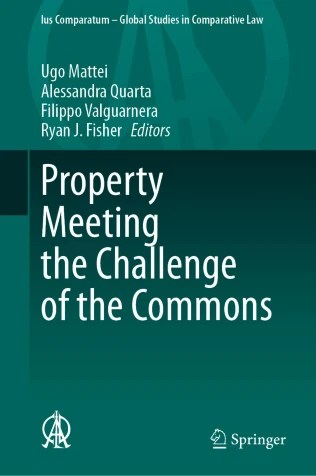
The book Property meeting the Challenge of the Commons – edited by myself together with Ugo Mattei, Alessandra Quarta and Ryan Fisher – was released in 2023 by Springer, marking the conclusion of an unusually long writing process that started ten years ago.
The reasons for the prolonged labour are the same that, in my view, makes the book an intellectual necessity. The commons – resources that are open to the enjoyment of all members of a society rather than allocated to an individual – is a concept that has been very well known and intensely studied in social sciences for a number of years, being in fact the subject that yielded Elinor Ostrom a Noble Prize for economics. The same enthusiasm cannot be observed among jurists, with the noticeable exception of some academic environments and some specific authors, such as Carol Rose in the United States and the Rodotà Commission in Italy. This phenomenon is paradoxical if one considers the importance attributed by mainstream economic studies about the commons to the institutions, and thus to the rules, that allow a commons to be managed successfully (i.e. without incurring in the “tragedy” famously envisioned by Garret Hardin). The commons would therefore seem a prima facie ideal field of research for academic jurists, offering desirable opportunities of interdisciplinary collaboration. It can therefore seem surprising that most legal scholars have, in the best of scenarios, a rather vague notion of this field of studies.
An in depth discussion about the causes of the gap between legal scholars and other social scientists cannot be explored here (allow me, however, to refer to a more extensive paper on the subject ‘Legal Ideology and the Commons: Why are Jurists Falling Behind?‘ ). It suffices to say that legal scholarship seems to be inherently conservative for reasons that are linked to the structural self-referentiality of law observed among others by Alan Watson and Gunther Teubner. This results in a tendency of most legal scholars to stay on well-established cultural and conceptual orbits unless an alternative idea has a sufficient gravitational pull to, so to speak, attract their attention and establish new orbits. The most important cultural aim of the book is therefore to present the commons as a relevant field of studies for legal scholars as well as to suggest the viability of the commons as an umbrella-concept for many social scenarios in which the traditional dichotomy ‘private property-public property’ seems less than useful.
While the relative impermeability of legal scholarship to the commons offered the opportunity to aim for an ambitious goal, it also presented unique challenges that required some methodological adjustments.
The Common Core method
The book was originally framed within the Common Core of European Private Law and follows its methodological and theoretical tenets with some necessary modifications. The Common Core is a well-known project with roots going back to Rudolf Schlesinger’s seminal comparative study on the formation of contracts, carried out at Cornell in the 1960s. Schlesinger’s main methodological innovation was to centre the questionnaire that the national reporters had to answer on concrete cases rather than on direct questions about the content of the law. Moreover, the cases were as far as possible written without using legally charged terms. The effect of this method was to bypass the notorious difficulties posed by language in comparative legal research and thus to generate a set of truly comparable data. The methodological insights of Schlesinger were adopted by Mauro Bussani and Ugo Mattei, when they started the Common Core of European Private Law in Trento in 1995, enriched by the theory of legal formants by Rodolfo Sacco. The marriage of these two components meant that the national reporters had to analyse the cases with regard to three levels: the operative (the likely outcome of the case), the descriptive (considering whether different formants provide different answers) and the meta legal (explaining historical and political forces that have shaped the rules at play). Moreover, the Common Core affirmed the important principle that the questionnaire had to be drafted in a collaborative way by the editors and the national reporters to ensure that the cases were as linguistically neutral and as meaningful as possible.
While the described methodology was clearly useful for a study about the commons, the editors were faced with two major challenges. The first one was to put together a group of national reporters. For more traditional Common Core-projects, this is usually not a significant hurdle. In the case, for instance, of a project about pure economic loss one can be reasonably sure that there will be a large pool of tort law specialists in the various jurisdictions and that they will feel sufficiently comfortable with the topic. In approaching the subject of the commons there were no such guarantees as the commons itself is not part of the established Western legal grammar and, thus, there are no large pools of national experts. Moreover, as the readers of the book will discover, the commons by their very nature slice not only through private law categories but also though the public law-private law divide. In other words, each national reporter had to address cases that required not only a good knowledge of property law but also of administrative and environmental law. Needless to say, finding legal scholars with such a broad profile turned out to be very difficult. We were therefore compelled to expand our research beyond the Common Core network and include the International Academy of Comparative Law (AIDC). This strategy proved successful.
The second challenge concerned the Common Core methodology’s focus on case-based questionnaires. While this approach is productive for most projects, it can become problematic when dealing with a notion that not only is not well established in modern mainstream Western legal grammar but indeed challenges many of the assumptions about the nature of property. There was a real risk that the reporters would have either missed the thread connecting the various cases or not reflected deeply enough on the existence within their respective legal systems of concepts that at least partially correspond to the commons. We chose therefore to draft a questionnaire divided into two parts. The first one follows the guidelines of the AIDC and is made of open-ended questions on the content of substantive law. The second part is case-based and follows the common core methodology.
Questions and results
It must preliminarily be noted that the questionnaire only explores one dimension of the various legal issues that are relevant for the commons, namely possible conflicts between the commons and property. The book does not investigate the various legal tools that commoners can use to manage the commons in a way that preserves the resource for future generations.
The first part of the questionnaire concerns three main topics: 1) exploring whether there is a legal category of the commons in the concerned legal systems, 2) public property and privatizations, 3) the constitutional protection of private property and whether it competes with other constitutional rights. The second part of the questionnaire comprises cases concerning disputes in housing, healthcare, food, water, natural resources, territory, culture, and climate. The questions were submitted to reporters from twenty legal systems generating answers from thirteen of them: Belgium, Canada-Common Law, Croatia, Germany, Italy, the Netherlands, Quebec, Russia, Slovakia, South Africa, Spain, Sweden, and the United States.
The comparative analysis of the acquired data has yielded some interesting results that paint a complex picture with some common trends. Here I will only be able to point at a few of the conclusions of the general report. The answers show that the analysed legal systems generally lack a precise definition of the commons. The reporters therefore explore neighbouring concepts that partially overlap with the commons, such as that of cultural heritage. It is also interesting to observe that the reports show that the historical disappearance of the commons has been furthered by the strengthening of national sovereignty. The academic debate in the different legal systems seems to be at least aware of the commons as a general concept, but legal scholars have generally not attempted a theoretical reconstruction of the commons as a legal category. As for the possibilities for individuals to protect the commons against competing interests, these vary widely depending on the specific resource. It is particularly interesting to observe that the legal strength of the commons is the weakest when it overlaps with the welfare duties of the state, even though most welfare state systems have experienced a significant withdrawal over the last few decades. A common problem is procedural, as individuals are in most cases not granted locus standi (for instance to protect a commons against privatization) unless they are bearers of interests that can be somehow differentiated from those of the general public.
I would like to conclude by underscoring that the commons, despite the difficulties encountered, have proved to be a very fertile ground for comparative and historical investigations. Readers who are interested in participating at future common core projects can visit the webpage (https://common-core.org/) or contact me directly.
Posted by Filippo Valguarnera, Associate Professor at Stockholm University
 British Association of Comparative Law