
The legal-geographical nexus
As a set of rules governing human activities, the law has always been in a special relationship with geography. No wonder, therefore, that the legal-geographical nexus has attracted scholars with a background in law, geography (both physical and human), anthropology, political science, human rights, and international relations. The dialogue among different disciplines has favoured the shift from law and geography to the interdisciplinary intellectual project which is known as ‘geographies of law’ or (critical) ‘legal geography’. This intellectual experiment is thriving: recent contributions by Tayanah O’Donnell, Daniel F. Robinson, Josephine Gillespie, Nick Bromley, Irus Braverman, Gail Lythgoe, Francesco Chiodelli and Stefano Moroni – to mention just a few – enrich and pluralise the debate. As a cross-disciplinary experiment, legal geography may prevent legal scholars from engaging with the topic under scrutiny: reducing the law to a geographical practice may indeed be unpalatable also for legal scholars actively involved in cross-disciplinary research. To sidestep this objection, suffice it here to remember that – to the best of my knowledge – the term was used for the first time by the renowned English legal historian Frederic William Maitland to address the relationship between a community and its territory, i.e. a series of legal and social practices that made up the complex web of relations between law, geography, power, and territory in medieval England.
Comparative law in the production of space
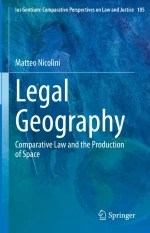
The book Legal Geography. Comparative Law and the Production of Space is a further contribution to the legal-geographical conversation. It investigates legal-geography searching for the authoritative meaning hinted at by the law within spatial production. As is known, the disciplinary construction of comparative law is implicated in the processes of legal-spatial production of the world. Intriguing as it is, both ‘construction’ and ‘production’ are consonant with the ‘spatial turn’ that took place in cultural geography in the late twentieth century. The stance was cross-disciplinary; power, space, place, and law were (and still are) considered to be mutually constitutive.
This book assumes that comparative law is well-equipped for assessing the law as a spatial practice. Firstly, it has cross-disciplinary ambitions of disengaging the law from formalistic and textual approaches. Secondly, it shows attentiveness to operational rules beyond the written law. Thirdly, its methodology is suitable for cross-disciplinary research because it possesses an empirical approach. Finally, it grasps what Pierre Legrand terms the ‘deep structures of legal systems’, exploring the connections between the law and its cultural contexts.
The cross-disciplinary ambitions of comparative law are made possible because comparative law shares several features with geography. Perhaps most striking of all is that both disciplines have an empirical approach and show attentiveness to how humans process the knowledge of the world which is also shaped by the context where it is produced. Geography also focuses on context acting as a process whereby the law takes part in the production of space.
Understanding spatial dimensions in legal geography
The shift from law and geography to legal geography is not a neutral academic exercise. Thinking in terms of legal geography means bridging several methodologies and perspectives applied in comparative law and geography. Not only is legal geography favoured by its empirical approach; but both disciplines also aim to order world knowledge and its legally relevant space-place-environment nexus. When coining the term ‘geography’, Eratosthenes of Cyrene (288-205 BC) had already realised how complex ‘Writing the Earth’ would be. Geography ‘writes’ the earth in its complexity – even in its legal complexity, as the legal systems of the world demonstrate.
As an interdisciplinary project, legal geography requires a good dose of ‘disciplined subjectivity’. Spatial construction favours the establishment of legal geography as a scientific project and opens it to fruitful encounters with discrete disciplines, thus accentuating its cross-disciplinary ambitions. As an open texture, it responds to practical necessities to experiment with a variety of methodologies, perspectives, and topics. Such a relativist tone equates with the idea of legal geography as a project benefitting from multiple approaches without worrying about which competing methodology is best.
The territorialised paradigm
This relativist methodological tone also explains how, through spatial production, the geographies of law change over time and place. The variety of methods, theories, even of topics, however, does not affect the academic ‘consensus’ around the disciplinary matrix of the geographies of law, which is primarily aimed at exploring how spatial normativities are made meaningful to human agencies.
This book assumes that the way we humans turn space into place has hints of territoriality. This might be explained because spatial production has traditionally been applied to processes of physical apprehension, political appropriation, and creation of meaningful territorial places. Once appropriated by humans, space is infused with experience and knowledge; and its demarcation is an attempt to take control of it, turning it into a politically meaningful context. Territory is contingent on how power spatially codes its own geographies through the law and adapts the territorialised paradigm to its own desired legal spaces. In other words, the turning of spaces into meaningful places has been governed by a territorialised paradigm; this is the ‘disciplinary matrix’ that assists us in identifying the operational rules of spatial production and to synthesise world knowledge.
Geographies of law as spatial production
This book identifies three processes of spatial production: the ‘law of spatiality’, the ‘spatiality of law’, and ‘counter legal geographies’.
The law of spatiality refers to how physical geographical features acquire significance in legal geography. It considers how the physical environment is processed by political power and coded through the law by assigning a new meaning to physical-human geographical features. This meaning refers not to the ontology of these features, but to their representation; not to their ‘essence’, but to their ‘existence’. Features already present in nature are reshuffled to match the desired ends of political power. For example, the components of the toposphere (e.g., watersheds) and hydrosphere (e.g., rivers) are turned into ‘natural’ borders; the seabed into Exclusive Economic Zones; outer space into ‘global commons’. The law justifies these processes conveying the idea that geography still reflects a ‘neutral’ reality and, in so doing, naturalises the new meaning.
The spatiality of law addresses the role of physical, human, and imaginative geographies in manufacturing legal systems. Natural, i.e. physical, and human geographical attributes have been used (and are still used) to legitimise and assert the superiority of a given legal system. Take, for example, the ‘Age of Discovery’, i.e. the interweaving of voyages and explorations that led to the expansion of European geographies of power through the world in the fifteenth and sixteenth centuries. Law and cartography were pivotal in disseminating and establishing Western legal geopolitics around the world. Likewise, the joint application of indexes, benchmarks, thematic mapping, and Geographic Information System is functional to the imaginative geographies of transnational actors. The relationship between ‘spatial technologies’ (cartography, remote sensing, and GIS, just to name a few) and globalisation marks a new type of maps, which is based on indexed pointing to the necessary convergence of national laws towards a common benchmark.
The third process of spatial production points to ‘counter legal geographies’, which reveal the role played by ideology in the production of space. In the spatiality of law and the law of spatiality, the role of political power in coding space through the law is slyly kept in the background. By contrast, counter legal geographies examine spatial production to display the potential of geographies of resistance to free places from power – or, at least to reveal its ideologically motivated production of space. If power assigns its own ‘preferred’ meanings to the spaces it produces, counter legal geographies challenge them by disclosing their being legal expressions of domination. This is patent, for example, in how Western colonisers deprived colonised people of their lands. Based on dispossession and colonial domination, these legal settlements are defied in post-colonial environments, where we experience the resurgence of pre-colonial legal spatial settlements whose performative force Europeans assumed to have silenced. Likewise, squatters’ illegal settlements oppose gentrification in urban spaces. The dialectic between domination and critique lies in this exchange of meanings; domination enforces its legal geographies encoding them in places, whereas critique contests this type of spatial production.
De-Territorialised Legal Geographies
This book finally argues that, as a disciplinary matrix, the territorialised paradigm has adapted real-world knowledge to new contexts, variables, and contingencies. In recent years, further processes of spatial production have emerged, such as the Anthropocene, globalisation, digital spaces, and the spaces of terrorism and climate-change. Although they seem to depart from the territorial matrix, these un-bounded spaces are still explicable in terms of the territorialised paradigm. De-territorialised spaces are still part of the political, legal, and geographical discourse, which provides the practical knowledge for manufacturing their unbounded environmental spatiality. Thus, their production is still essential for the establishment of legal geographies of power. Evidently, the matrix still provides an explanation for their legal spatial production, still satisfying the human ambition to grasp the world intellectually and order its knowledge to make both meaningful and useful to us.
Posted by Matteo Nicolini
Law Department, Verona University, Verona, Italy.
Newcastle Law School, Newcastle University, Newcastle upon Tyne, UK
 British Association of Comparative Law