
Studies on mixed jurisdictions have proliferated during the past decades. A number of law review articles and of edited volumes served in that process of contrasting experiences. The seminal Mixed Jurisdictions Worldwide merits special attention, since it became the vade mecum in the field. Other volumes have gathered contributors from different mixed jurisdictions, such as Mixed Jurisdictions Compared: Private Law in Louisiana and Scotland, hence attaining synergy. Scholars interested in the mixed jurisdictions have gathered around the activities of the World Society of Mixed Jurisdiction Jurists already for more than two decades, since the first World Congress held in New Orleans in November 2002, when the theme of salience and unity in the mixed jurisdiction experience paved the path that would follow. That first gathering was followed by meetings in Edinburgh (2006, “The Boundaries of Unity: Mixed Jurisdictions in Action”), Jerusalem (2011, “Methodology and Innovation in the Mixed Jurisdictions”), Montreal (2015, “The Scholar, Teacher, Judge, and Jurist in a Mixed Jurisdiction”), and more recently Malta (2023, Mixity in Private Law and/or Public Law).
Scholars that look at the interplay of systems within a jurisdiction tend to explore “mixity.” That word refers to the characteristic of mixedness that is captured in French, and sometimes in English, by mixité. Even when “mixity” is not in the Oxford English Dictionary, the choice of its use helps to attain a common narrative amongst those that engage in studies on these jurisdictions.
According to a traditional view, mixed jurisdictions offer a habitat where the preponderant legal system is no longer “pure.” In some mixed jurisdictions, the influence of the common law is sensed within a civil law jurisdiction. There, the private law is generally based on continental civil law while the public law is typically Anglo-American in heritage. Three characteristics distinguish these systems from the great number of plural systems found around the world: the unique content of the mixture (civil law/common law); the structural division of the mixture into private and public spheres and the undisputed acknowledgement of this divide by internal observers and actors. In other systems, mixity is present between common law and Sharia law, or within customary law and civil law, just to mention some variations of interaction between systems. Examples of mixity are to be found around the world. This “third legal family” consists of roughly 16 jurisdictions, such as Israel, Malta, the Philippines, Puerto Rico, Quebec, Scotland, South Africa, and Sri Lanka. It also includes some less-explored mixed jurisdictions such as Botswana, Lesotho, Mauritius, Namibia, St. Lucia, Seychelles, Swaziland, and Zimbabwe.
Yet a question arises when looking at the spaces within which the law evolves: are all jurisdictions mixed? On the one hand, as Vernon V. Palmer explained in Mixed Jurisdictions Worldwide: The Third Legal Family, there are legal systems that are often described as “mixed” because they combine elements of the common law and civilian traditions, and perhaps others; and it is possible to articulate the features that characterize the systems that are usually described as mixed. On the other hand, it is also possible to take a wider view. Reinhard Zimmermann has written in his Roman Law, Contemporary Law, European Law: The Civilian Tradition Today, that “all our national private laws in Europe today can be described as mixed legal systems. […] None of them has remained ‘pure’ in its development since the Middle Ages. They all constitute a mixture of many different elements: Roman law, indigenous customary law, Canon law, mercantile custom, and Natural law theory, to name the most important ones in the history of the law of obligations.”
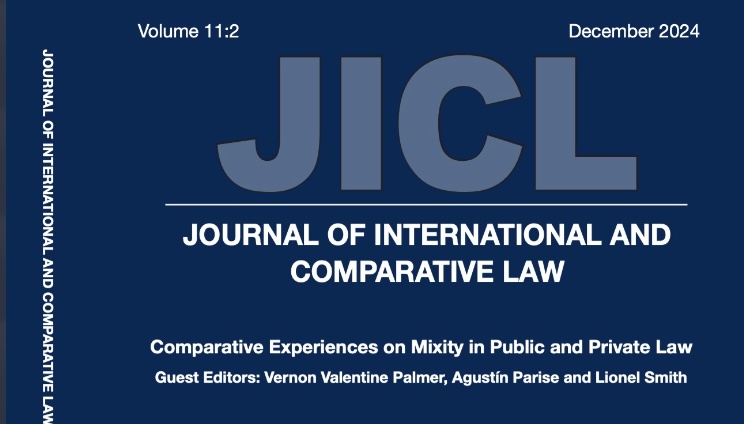
The Fifth World Congress on Mixed Jurisdictions offered a fertile ground for disciplinary studies. This academic gathering was held in Malta in June 2023, and brought together scholars and jurists from around the world who are interested in the study and advancement of the mixed jurisdictions. It was hosted by the Faculty of Laws of the University of Malta, and more than 44 speakers drawn from four continents made presentations. The proceedings of that academic event were published as a special issue of the Journal of International and Comparative Law. This blog entry returns to those proceedings, and builds on the guest editorial to that special issue.
The theme of the Fifth World Congress in Malta was “Mixity in Public and Private Law,” a theme that went beyond the traditional emphasis on private-law mixtures and exposed underexplored forms of public-law hybridity in the mixed jurisdictions. This theme acknowledged the basic truth that constitutions, courts, criminal law, judicial procedure, and other public law subjects may embody not only the traditional mixtures of common law and civil law but provide the locus for new mixtures to develop.
Constitutions in the mixed jurisdictions usually carve out a domain for the civil law that helps to ensure its continued existence and tends to perpetuate its functional interaction with common law elements. The Canadian constitutional habitat creates what Rosalie Jukier and David Howes call a “Mixed Jurisdiction Court,” one in which a robust comparative law dialogue has taken place over the years. The authors highlight bi-jural exchanges as the Justices speak to each other in Canada through their judgments, dissents, and concurring opinions. That dialogue reveals that traditions have co-existed and have been co-constructed.
Ian S. Forrester offers an expert insider description of how the Courts of the European Union have been shaped by both civil and common law traditions. The author describes a court that not easily fits into civil law or common law categories, and regards it as a unique institution that has been charged with resolving problems the treaties did not settle. He deals with a court that is undoubtedly a multi-cultural and multi-lingual institution and is inevitably engaged with the mixed legal traditions of Europe.
Markus G. Puder challenges readers to listen to the special “voice” of the mixed jurisdictions and to consider the advantages that this modulated register brings to the solution of important international questions. He argues that mixed jurisdictions are uniquely positioned to shape the trajectory of the comparative law conversation because they have a voice transcending legal families, traditions, and cultures. The author maintains that the rich texture of the mixed jurisdiction voice can penetrate and enrich even the most disparate and hitherto underexplored worlds of public international law and religious law.
Languages is once more addressed in this special issue in Gianluca Parolin’s study of Malta’s linguistic history. Based on fieldwork, the author finds that although Maltese has been the official language in litigation and the courts since 1934, and although on the surface there has been no official change in that dispensation, in the meantime English has impacted Maltese legal language below the surface, particularly by investing Italian loan words with new English connotations. This underground transformation, without change of morphology, may ultimately affect the future of civil law in Malta.
François du Toit addresses the German term Drittwirkung as presented in the South African law of gifts. That term refers to the impact of public or constitutional norms on private law, and it enables the author to explore the jurisprudence of South African courts and to engage in a comparative excursus on Dutch law. Adopting what he calls a “decidedly libertarian view of the matter,” the author concludes that the state should intrude minimally on its citizens’ private legal affairs.
Henry Ordower shows that tax law is both a hybrid of civil and common law and a hybrid of public and private law. The author observes that the USA relies not on common law judicial development to fill out its tax system but makes primary recourse to the legislature and to the compiling of statutory base. The judges have ceded the creative role of resolving ambiguities and new questions to the legislature. In the civil law countries of Europe, however, the opposite tendency exists. The civil law jurisdictions have become common law-like in relying on the courts and taxing agencies to limit and define taxation rules.
Ana Mercedes Lopez Rodriguez utilises the mixed jurisdiction experience with class actions as a measuring rod to determine whether Europe’s well-known hostility to US-style class actions is based on legal culture or on political concerns. The question is highly relevant as the EU countries are in the process of transposing a directive on this topic into their national systems. In the years to come European legislators will need to find the “point of equilibrium” where the marginal benefit of successful consumer protection equals or exceeds the marginal cost of abuse and negative impacts.
The proceedings of the Fifth World Congress suggest that a living legal system speaks and breathes through its languages, its codes, its precedents, its institutions, its judges, its constitution, and its customs. The mixed system is not a set of static or watertight compartments. It is a whole in which all parts may interact. It breathes organically. There are no watertight divisions between private law and public law, no disconnect between, say, constitutional principles and tort law. Any public-law change of official language or in the recruitment or training of judges, will have ramifications for the entire legal system, including its private law.
This special issue offers multiple approaches to the mixed jurisdictions. More approaches to the mixed jurisdictions will follow in 2026 during the General Congress of the International Academy of Comparative Law. On that occasion, the mixed jurisdictions will return to the main stage, when scholars will address the creation, evolution, and value of these spaces for comparative law.
Vernon Valentine Palmer (Tulane University), Agustín Parise (Maastricht University), and Lionel Smith (University of Oxford)
 British Association of Comparative Law
1 Comment
Comments are closed.