
Introduction
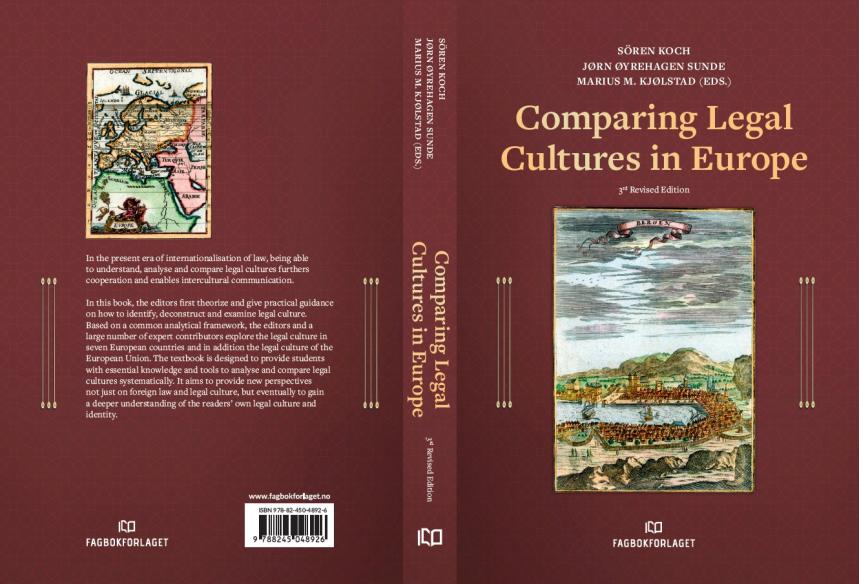
The third edition of Comparing Legal Cultures in Europe marks a significant milestone in the teaching and study of comparative law. Edited by Sören Koch, Jørn Øyrehagen Sunde and Marius M. Kjølstad, the volume builds upon the foundations laid in the first two editions but introduces a distinctly new pedagogical orientation. This reorientation is not merely cosmetic; it reflects a deeper reconsideration of how comparative law should be taught, understood, and applied in the twenty‑first century.
For students, particularly in the Nordic countries but also across Europe, the editors have sought to create a textbook that is both accessible and intellectually rigorous. For scholars, the book offers an analytical model of how legal cultural comparison can be integrated into debates about comparative law, and the role and function of law in society.
This post will highlight the pedagogical innovations of the new edition, situating them within the broader context of comparative legal studies, and reflecting on their potential for teaching and scholarship.
Pedagogical Challenges of Teaching Comparative Law
Comparative law has long struggled with a pedagogical dilemma. On the one hand, it is a discipline that requires breadth: students must be exposed to multiple legal systems, traditions, and cultures. On the other hand, it requires depth: without careful contextualisation, comparisons risk becoming superficial or misleading.
Traditional textbooks often oscillate between these poles. Some emphasise doctrinal detail, providing exhaustive accounts of foreign legal systems or specific legal problems, but overwhelming students with information. Others adopt a more thematic approach, focusing on broad issues, but sacrificing a more holistic perspective. The editors of Comparing Legal Cultures in Europe have sought to solve this dilemma by adopting a pedagogical model that is both structured and flexible. The so-called legal cultural model (LCM) makes it possible to identify and explain similarities and differences of selected features of legal cultures by providing accessible but sufficiently detailed knowledge.
Student‑Tailored Design
The third edition is explicitly tailored to the needs of students. The editors recognise that today’s students approach comparative law with diverse backgrounds and expectations. They are trained in national legal systems that emphasise doctrinal , they are also increasingly aware of the importance of transnational and international perspectives.
The book therefore adopts a student‑centred design. Chapters are structured to highlight selected legal cultural features, provide historical explanations, and offer comparative insights without overwhelming detail. Chapters on the legal cultures of Norway, Sweden, Denmark, Scotland, England & Wales, Germany, France and the EU begin with some contextual information such as location, history, politics and economy, before discussing different elements of legal culture, and end with reflective exercises that encourage students to engage in critical thinking and discuss the content of the chapter. This aims to help them gain new perspectives on their own legal cultures and legal identities.
Focus on Legal Culture
A distinctive feature of this textbook (which was already present in the previous editions) is its emphasis on legal culture, defined as ideas and expectations of the law made operational by institutional (-like) practice. Rather than treating comparative law as a purely doctrinal exercise, the editors insist that law must be understood within its cultural, historical, and social context. A strong focus is placed on the interplay between attitudes, behaviour and values of practising lawyers and their embeddedness in institutional practice, such as the constitutional framework, the system of norm production and conflict management.
This approach reflects the recent developments in legal scholarship, which have for some time emphasised that comparative law has become a pluralistic and interdisciplinary field. To serve different purposes and objectives, comparatists have developed various tools to critically analyse the relationship between law and society. As David Nelken correctly observes: Legal Culture has become a key concept in this regard. The legal cultural perspective in this textbook encourages students to see law not merely as a set of rules, but as a living institution embedded in social practices, constitutional structures, and cultural features shared by most lawyers but also impacted by general features of regional, institutional, national and supranational cultures.
Innovative Formats and Assessment Techniques
The editors have also embraced innovative pedagogical formats which they are applying actively in their multi-cultural classes and for students going abroad. Recognising that students today engage with law through multiple media and artificial intelligence, the editors encourage the use of blogs, podcasts and other digital resources discussing legal topics comparatively.
This is not a superficial development. By integrating alternative formats in their teaching, the editors seek to broaden the scope of comparative law, making it more accessible and engaging. Students are encouraged to produce their own comparative reflections in diverse formats, thereby developing skills that go beyond traditional academic writing. The book contains knowledge and helps students develop corresponding analytical skills to disseminate comparative insights and discussions when using these formats.
Constitutional Framework as an Additional Institutional Element of the LCM
One of the most striking innovations is the integration of the constitutional framework into the LCM. The constitutional framework – regardless of whether the constitution is written, consists of one or several sources or is based on conventions – provides a natural point of orientation for comparative analysis: it touches on fundamental rights, questions of governance and procedures, while also reflecting the impact of legal traditions and cultural values or attitudes in determining a constitutional and consequently legal cultural identity. If, as Nelken suggests, culture is more about who we are, not just what we do, the form and content of the constitutional framework are important building blocks of any national legal culture. Exploring questions such as the extent and form of judicial review—examined not merely in theory but in practice—or assessing how flexible and resilient a constitutional order proves to be in operation, provides valuable insights into the underlying legal ideology, political dynamics, and cultural values and attitudes that shape the complex relationship between law and society. Furthermore, the constitutional framework determines the limits within which norms are produced and applied, often also the way they should be interpreted and enforced.
Collaborative Scholarship
As with the previous editions, CLC is a product of collaboration among young, distinguished scholars from across Europe, all of them using the LCM in their teaching, and most also in their research. Alongside the editors, contributors of this volume are Andrew Simpson (Scotland), Robert Taylor (England & Wales), Axel Hjo (Sweden), Morten Kjær (Denmark), Iris Nguyen‑Duy and Sunniva Bragdø‑Ellenes (France), and Johann Ruben Leiss (European Union). Drawing on more than a decade of classroom experience with the LCM—dating back even before the first edition in 2017—the model’s pedagogical value has consistently been affirmed. Despite the recent rise of AI‑based tools, the LCM remains a proven and effective framework for comparing legal cultures.
This diversity of contributors reflects the editors’ pedagogical commitment to plurality and intimate knowledge of the legal cultures presented in the book. Students are exposed to multiple voices, perspectives, and methodologies, thereby learning that comparative law is not a monolithic discipline based on one specific methodological approach but a dynamic exercise.
Structure and Content
The book is organised thematically, starting with chapters introducing the operationalised concept of legal culture and the LCM as an analytical tool as well as a guideline for conducting legal comparison (COMPASS), including, but not limited to, legal cultural comparison. In the new edition, the number of legal cultures has been reduced to eight and focuses on European legal cultures, as these are most relevant for the intended audience. Each chapter combines an overview of institutional and intellectual features that invite cultural contextualisation. Furthermore, pedagogical features such as guiding questions, case studies, and reflective exercises have been added.
By focusing on selected elements of legal cultures, the editors provide students with a framework for comparing legal cultures. This allows them to explore broader issues—such as the role and style of courts, the prevailing ideals of justice, legal methods, and the professionalisation and internationalisation of the law—while relating their analysis to specific legal systems, substantive norms and the application of law. In other words, the book includes insights into both law in action and law in the mind, providing them with the foundations and tools for both macro- and micro-comparison.
The editors have deliberately avoided the temptation to provide exhaustive detail. Instead, they focus on selected elements and structures, encouraging students to engage critically with the material and to pursue further research. This reflects a pedagogical philosophy that values active learning over passive absorption.
Potential Challenges
Of course, the new pedagogical approach is not without challenges. Some may argue that the emphasis on accessibility risks oversimplification. Others may question whether a cultural perspective is sufficient to provide students with any genuine understanding of foreign law or its cultural context. One might also object that the specific internal legal view of culture undermines other important aspects such as confidence in the legal system, general acceptance and role of law in society, the role of linguistics, etc.
The editors are aware of these objections and have sought to address them by emphasising understanding over detail. Considering that the main purpose of the book is to provide students with new perspectives on law, not least their own legal culture, the book does not aim to replace traditional scholarship; rather, it complements it, providing students with multiple entry points into the legal cultural studies.
Conclusion
In an era of increasing transnationalism, the pedagogical innovations of Comparing Legal Cultures in Europe are not merely timely; they are essential. The book offers a vision of comparative law as a dynamic, student‑centred discipline that is attuned to the cultural, historical, and social dimensions of the law.
Posted by Professor Sören Koch, University of Bergen.
 British Association of Comparative Law