
Introduction
This contribution is about the preparation of Greece’s Civil Code, which was completed in 1940 and came into effect in 1946. This code governs the majority of civil law matters in Greece to date. One of the Greek Civil Code’s major achievements, which this contribution explores in detail, has been the fact that it unified the four Interwar civil law regimes of Greece into one. For legal and historical reasons, it took modern Greeks more than 100 years to unify their country in civil law matters, after the liberation of the country from Ottoman rule. Beyond this, the Greek Civil Code is one of the lesser-known examples of comparative legal research in the world. Yet, exemplary comparative legal research has been put into this project, which, by the time it came into life, was long overdue. From a comparative point of view, this is a civil code that amalgamates ideas from Eastern Roman law and German civil law with the addition of a number of ideas from other European laws. The powerful influence of Eastern Roman law and German law on the Greek Civil Code is explored herein. As such, special regard shall be had to two major legal sources to the Greek Civil Code: the German Pandectists and the Harmenopoulos’ Hexabiblos, an epitome of Eastern Roman Law that medieval but also most of the modern Greek lawyers would traditionally use for addressing their civil law matters up until 1946.
The Four Civil Law Regimes in Interwar Greece
Early 20th century Greek civil law, unlike French pre-Napoleonic civil law, did not quite exactly comprise 360 different legal customs of general and specific application (Zweigert & Kötz 1998, 77), as these were found in the different parts of France. Nonetheless, Greek civil law between the First World War and the Second World War was fragmented for the limited geographical-legal space of a country like Greece, it being governed by four different civil law regimes (Παπαγιάννη et al. 2015, 202), namely:
a. Byzantine Roman civil laws and certain modern civil law instruments (e.g. the Law on Mortgages of 1836; the Law on Liability from Car Accidents 1911) which governed mainland Greece and most of the country’s islands; the Muslim minority in Greece could otherwise directly invoke Sharia;
b. the Civil Code of Crete 1903 which governed the island of Crete;
c. the Samian Civil Code 1899 which governed the island of Samos; and
d. the Ionian Civil Code 1841 which governed the Ionian Islands.
To make things even more complicated, another traditionally Greek territory, the Dodecanese (Rhodes being its principal island), was governed by the Italian Civil Code of 1865 between 1932 and 1942, and after 1942 by fascist Italy’s new Civil Code of 1942, which applied in this part of Greece up until its return to Greece in 1947. The reason for this was that the Dodecanese was officially a territory of the Italian Kingdom between 1932 and 1943; a territory of the Italian Social Republic between 1943 and 1945 and, again, a territory of the restored Italian Kingdom between 1945 and 1947, even though during this last period of nominal Italian occupation it was actually the British that held military control of this area, i.e. up until the 31st March 1947, when the British passed military control of the Dodecanese to Greece.
All four civil law regions (mainland Greece with most of the islands, Crete, Samos and the Ionian Islands) would otherwise become legally unified under the Civil Code of 1946. In 1948, the Greek Civil Code of 1946 extended its territorial remit to the Dodecanese, which was formally united with Greece in the same year. In the Interwar years, the application of these five different systems of civil law in Greece after 1923 (i.e. after the territorial losses of Smyrna, the Asia Minor area around Smyrna and Eastern Thrace through the Treaty of Lausanne) could be illustrated by the use of different colours as on the map below (Figure).
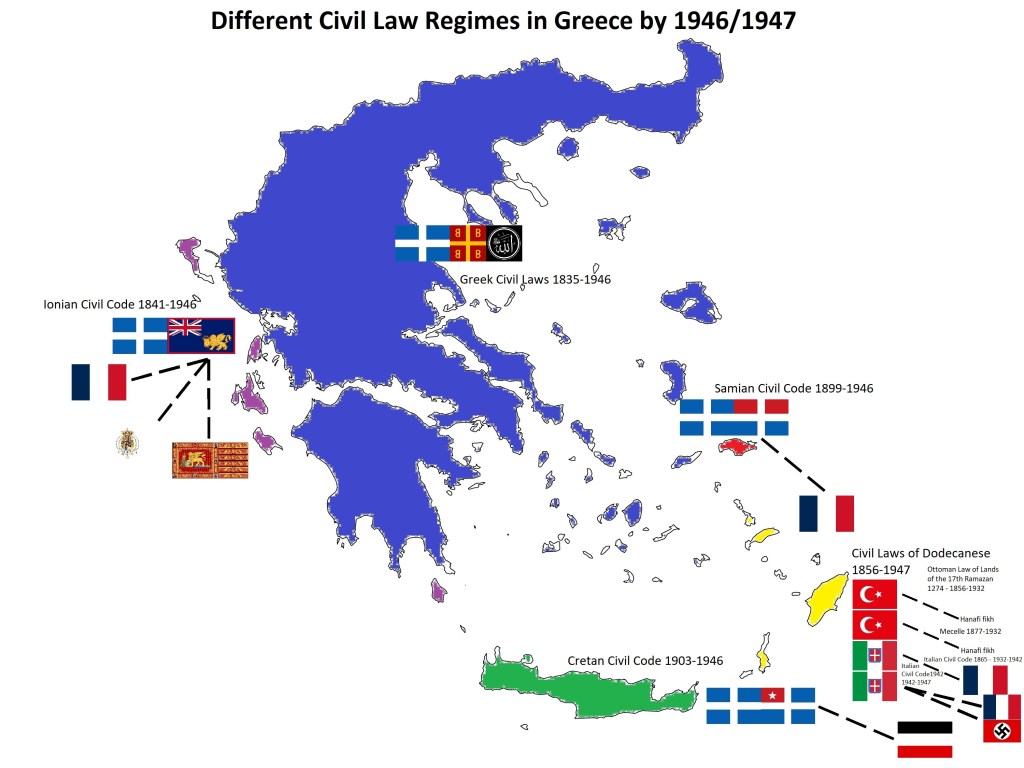
Figure © the author
The Venizelos Government’s Instruction for Preparatory Work for a Civil Code in 1930
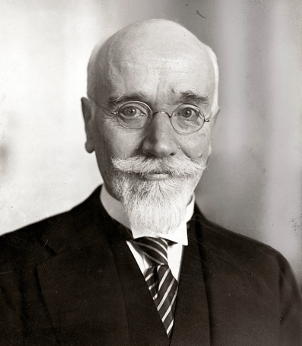
Eleutherios Venizelos
After a number of abortive attempts, preparatory work to create a modernised civil law for Greece and to unite the different geographical legal regions of Greece under the same civil code commenced with the creation of a Commission for the Codification of Civil Law in 1930 under the Venizelos government. A previous draft of a Civil Code in the 1870s, predominantly based on the French Civil Code and to a lesser extent on the Dutch, the Saxon and the Italian Civil Codes, never came into being. Apparently, ‘[t]he French Civil Code exercised a strong attraction on the [19th Century] Greeks in revolt’ (Zepos 1946, 57) but such an attraction was not meant to last. Greece, like Japan, never adopted a Civil Code largely based on the Code Napoléon, even though this was the original plan both in Greece and in Japan in the 1870s. In any case, a five-member preparatory commission under Professors Georgios Balēs, Konstantinos Demertzis, Konstantinos Triantafyllopoulos and Georgios Maridakis (all from the University of Athens) and Advocate Petros Thebaios was formed to draft the civil code. This commission was followed by a second twenty-five-members commission which was to examine, re-assess and revise the first commission’s draft. Following the German Pandectists’ division of books, initial drafts of the five books of the Greek Civil Code were prepared.
The Metaxas Government’s Finalisation of the Civil Code in 1940

Ioannis Metaxas
Whereas the prepared code was a united legal text, it was not a wholly unified one. Professor Balēs, the driving spirit behind the Greek Civil Code, was thus assigned the task of re-organising and unifying the code into a coherent whole in 1938. The Metaxas Government was practically interested in the completion of what was now a long overdue code. On the 17th of December 1939 the final draft of the Greek Civil Code was complete. The Civil Code was thus finalised during the Metaxas Government in 1940. Law 2250/1940 contemplated the full enactment of the code on the 1st of July 1941. However, the invasion of Greece by the Germans and the subsequent triple occupation of the land by Germans, Italians and Bulgarians interrupted the enactment of the code. The code’s enactment was formally suspended in 1941, after the Germans took control of Thessaloniki on the 9th of April 1941 and control of Athens on the 27th of April in the same year.
Post-War Attempts to Enact the Code – The Tsaldaris Government’s Re-Enactment of the Original Systematised Code of 1940

Konstantinos Tsaldaris
After the evacuation of the main occupying forces of Germany from mainland Greece by the end of October 1944, the code’s enactment was effectively delayed once more – this time by the Greeks themselves, i.e. by the Voulgaris government, which instituted a three-member committee under Areopagite Judge Ioannis Sakketas and National and Kapodistrian University of Athens Professors of Law Konstantinos Triantafyllopoulos and Georgios Maridakis in 1945 in order for them to revisit the code. It was otherwise on the 8th of May 1945 when the final German forces left Greece from such places as Melos and Crete.
The enactment of the code was now delayed because of proposed amendments by the professional class of lawyers in Greece – these amendments did not always respect, however, the unified spirit that Professor Balēs wished to infuse and actually managed to infuse in the code. In protest, Professor Balēs refused to participate in the new committee which was to work on the code again. A new amended code, which was a short-lived one, came into effect on the 23rd of February 1946. The code was subsequently repealed by the Tsaldaris Government which retroactively enacted the original ‘Balēs’ code in 1946. With considerable revisions to it, this code governs most civil law matters in Greece to this day.
A Civil Code for Greece to Replace the Four Civil Law Regimes in the Country
Greece is a relatively small geographical and legal space to be able to sustain four diverse civil laws in its territory. If one added to these the different civil law regime in force in Rhodes and the rest of the Dodecanese up until 1947, the situation was even more complicated. As such, the 1946 Greek Civil Code was a welcome occurrence both from the practical as well as from the scholarly point of view as it replaced the old civil law regimes in Greek legal space.
Traditional Influences of Eastern Roman Law on Greek Civil Law
Prior to the Greek Civil Code 1946, mainland Greeks traditionally aspired to Eastern Roman Law for their civil law matters – in particular the Harmenopoulos’ Hexabiblos 1344-1345 (Law Book in Six Volumes / Promptuarium / Шестикнижжя / Εξάβιβλος ή Πρόχειρον Νόμων). This was effectively a polished epitome of Eastern Roman Law, and its first printed copy would have been published in Paris in 1540.
Governor Kapodistrias, the first governor of liberated Greece from Ottoman rule, would instruct the courts of Greece through Resolution of the 15th December 1827 ‘to follow the laws of the [Eastern Roman] Emperors, as found in Harmenopoulos’ Hexabiblos’. During his lifetime, Harmenopoulos was a renowned lawyer of the Eastern Roman Empire, who lived in Thessaloniki, the Symbasilevousa (the Co-reigning City of the Eastern Roman Empire, the second most important city of the empire after Constantinople, the Reigning City, the capital of the Empire, or the Basilevousa). His title was that of ‘Universal Judge of the Romans’ in Thessalonica (Καθολικός Κριτής Θεσσαλονίκης).
In judicial ranking terms, that made him a high-ranking judge in the late Eastern Roman Empire. The modern Greeks found it only natural to refer to Harmenopoulos’ legal texts for addressing their civil law matters. Indeed, by royal decree in 1835 the then newly created Greek Kingdom adopted Harmenopoulos’ Hexabiblos as the civil law of the land (Zepos 1946, 58). The traditions of the modern Greeks pointed to the c. 1300-year long legal traditions of the Eastern Roman Empire, as epitomised in the Hexabiblos. These legal traditions and laws were the civil law of the Greeks as Eastern Romans; these were the civil law of the Greeks under the Ottoman rule through the Ecumenical Patriarchate’s jurisdiction; these were the modern civil law of most of the Greeks from 1835 until 1946 (Zepos 1946, 57). At this point it should be noted that the original 1835 royal decree has been traditionally interpreted broadly by the Greek courts, them taking into account in the adjudication of civil matters both the Hexabiblos as well as the entirety of Byzantine law from the times of the Justinian codification to the dissolution of the Eastern Roman Empire (Dacoronia 2003, 663).
Influences of the School of the Pandectists
Greece, a country renowned for its comparative law traditions from ancient times to modernity, from Aristotle and Theophrastus to Tribonian and from such scholars and jurists as Harmenopoulos to Zepos, Markesinis and Kerameus, considered it only a natural matter to develop a new civil code
a. by maintaining its Eastern Roman legal traditions and
b. by infusing in such a code what the country’s legal circles perceived the best and the finest of contemporary legal jurisprudence.
The choice of the Greeks in favour of Eastern Roman Law was an obvious one. Aside from the high degree of sophistication of Eastern Roman Law, the modern Greeks were, for historical reasons, closest to the legal traditions of the Eastern Roman Empire. Moreover, their choice in favour of German civil law, as in the German Civil Code 1900 (for influences beyond German law, see Zepos 1967, 397), was, on the one hand, the result of the increasing influence of the German Pandectists over the Greek law professoriate at the University of Athens already from the 19th century and well into the 20th century and, on the other hand, the result of comparative legal research (Zepos 1967, 397; Dacoronia 2003, 663-664), German law coming closest, amongst modern European laws, to the substantives and the traditions of Eastern Roman Law (Zweigert & Kötz 1998, 155). Of course, the French Civil Code would come closer, in form, than the German Civil Code would, to the Justinian codification. The preference of the Greeks over modern German civil law was however made on substance rather than form, as modern German civil law has traditionally been one that would come closer to Roman tradition, as compared to modern French civil law, which would come closer to Germanic custom (Zweigert & Kötz 1998, 88). Hence this was an additional reason for their choice of the German Civil Code as a model.
So Close Yet So Far – And Close but not too Close to the German Civil Code
And yet, the Greek Civil Code (GCC) should not be taken to be a ‘German’ code stricto sensu (Zepos 1946, 60; Zweigert & Kötz 1998, 156). A code modelled on another code does not necessarily make the former always highly similar to the latter: it is the way a code’s substantive provisions are put together, put into practice, implemented and applied in courts rather than the modelling of a code per se that matters the most in assessing comparative legal projects such as the GCC. For instance, whilst much of the code is structured and based on the German model, the code’s legal language is nowhere near as complex or overburdened as that of the BGB of 1900 (a feature of the BGB that has been the subject matter of certain considerable criticism in Germany itself). Also, ‘[i]n all likelihood, the influence of German law on Greek private law is bound to decrease in the long run’ (Baetge 2012). So too, the Greek Civil Code, whilst not as laconic as the Japanese Civil Code of 1896 with its c. 1000 Articles, another code that has been influenced by German legal thought, is still more laconic than its German counterpart. Thus, the Greek Civil Code comes with c. 2000 Articles to it, when the German Civil Code spans to c. 2400 Paragraphs.
Additionally, the Greek Civil Code seems to slightly, albeit naturally, depart from the old Prussian virtue of strict legal Ordnungssinn (or ius strictum approach), which seems to characterise the German Civil Code to a significant extent, the spirit of the Greek Civil Code coming decisively closer to a more open-ended and ius aequum approach (Dacoronia 2003, 665). In this respect the German Civil Code seems somewhat more Platonic, whilst the Greek Civil Code feels somewhat more Platonic-Aristotelian. To put it otherwise, the German Civil Code, close to the German School of Conceptual Jurisprudence (Begriffsjurisprudenz), is effectively about a conceptual Platonic perception of the world; it is orderly and disciplined; it is about didactic legal conceptualism. The Greek Civil Code, on the other hand, whilst it is still orderly and disciplined and still about a predominantly conceptual Platonic perception of the world, is somewhat more adaptable and flexible than its German counterpart. For instance, in the absence of concrete civil code provision, Greek judges would not probably be as ‘free’ as their Swiss colleagues would be in reaching their decisions, especially considering the well-known amongst comparative lawyers Aristotelian-Nicomachean provision of Art 1(2) of the Swiss Civil Code of 1907 (Siehr 2012 citing Aristot. Nic. Eth. 5.10.5). Nonetheless, in this type of situation, i.e. in the absence of concrete civil code provision, Greek judges would still be ‘freer’, under their code’s deliberately wide and vague provisions such as Art 288 (Good Faith), than their German colleagues would be under the equivalent provisions of the BGB, especially considering the BGB’s traditional ius strictum approach and, of course, the traditional fear of the German legal and political elites for a Richterstaat (a state ran by judges). Modern Greece is not, of course, a Richterstaat; nor is Germany. In the Greek Civil Code, however, the presence of clauses on good faith and good morals on a wide scale, clauses that would amount to mutatis mutandis equitable provisions, would actually allow the Greek judiciary certain noteworthy flexibility to modernise the law, through their decisions (Dacoronia 2003, 665 citing Georgiades 1996, 131), thus allowing us to maintain that the Greek Civil Code comes somewhat close to an Aristotelian perception of the world too (cf. Aristot. Nic. Eth. 5.10.5).
Furthermore, in the German Civil Code, one does not encounter, or at least one did not encounter up until very recent decades, direct equivalents of Arts 57 (Civil Protection of Personality) and 388 (Dissolution or Re-Arrangement of the Contract Due to an Unforeseen Change of Circumstances) GCC, ideas which German civil law had to inevitably recognise and adopt through the judicial decisions of the German civil courts and so on (Dacoronia 2003, 665, 667). The German legislator had to also step in, in 2002 (Zimmermann, 2005, 1-3), albeit with more than considerable delay, considering that the BGB was already 102 years old by the time, by bringing into effect § 313 BGB so that the German Civil Code would come closer, in formal substantive terms too, to more modern civil law approaches in the area of force majeure and frustration of contract matters, approaches which the Greek Civil Code had already recognised. More interestingly, in the law of torts, the Greek Civil Code hovers between specificity and generality, thereby successfully combining the strengths of the German Civil Code with its more specific solutions in the area of delicts and the strengths of the Swiss and the French Civil Codes with their general clauses in the same area. Thus, Art 914 GCC (Tortious Liability and Compensation) is much more sweeping than the rather conservative § 823(1) BGB, in that the former does not require the violation of an absolute right for compensatory mechanisms to be triggered (Baetge 2012).
Equally, the Greek Civil Code, reflecting the German Civil Code, is divided into a General Part, the Law of Obligations, the Law of Property, Family Law and the Law of Succession (Zweigert & Kötz 1998, 155). However, whilst the Greeks chose to structure their Civil Code of 1940/1946 based on the German Civil Code 1900, the fluidity of their code’s text treads midway between the simpler and more straightforward tone of the Swiss Civil Code of 1907 and the more abstract and conceptual character of the German Civil Code, even though one would be able to also surely claim that the elegance of expression of the Code Napoléon has not manifested itself in the Greek Civil Code. Thus, the Greeks did not produce an elegant code in the way the French would produce their civil code but rather one that was to mostly cater for the professional class of lawyers in their country. This is by all means peculiar, considering the philological and terminological elegance and precision of the Greek language, a language that would allow for the creation of a code that could be accessible to both professionals and lay persons.
The Spirit of the Greek Civil Code
In one of his immortal lines, Kahn-Freund asks us to ensure that in our teaching of comparative law, we teach our students to be both proud and humble (Kahn-Freund 1965, 30). The Greek Civil Code comes quite close to this ideal, in that, as a comparative legal project, it teaches Greek jurists that their civil code is one that operates somewhere between the realms of pride and humility. Indeed, the Greek Civil Code can be taken to be both a humble and a proud code. It is a relatively humble code because it does not pretend to be the perfect conceptual abstract legal machine (cf. Zweigert & Kötz 1998, 145 citing Schwarz 1950, 8) that the German Civil Code seems to mostly strive to be; it is proud because it salvaged certain of the Eastern Roman legal traditions of the Greeks to a considerable extent. Such classic Roman law and Eastern Roman law ideas as the ideas found in Arts 281 (Good Faith – Prohibition of Abuse of Right – Exceptio Doli), 914 (Tortious Liability and Compensation, as explained above, this provision being very reminiscent of classic Rome’s Lex Aquilia), 1008 (Roots and Offshoot Branches of Neighbouring Property), 1024-1026 (Treatment of Rain Waters) GCC are ideas that are found throughout the code.
At other times, however, the code’s original provisions, provisions that emanated from the ancient Greek, Roman and Mediterranean worlds and traditions, such as Arts 1387 (Husband as Head of the Family – mutatis mutandis Pater Familias principle) and 1389 (Exclusive Wife Responsibility for Household Chores), have been amended to such an extent that their original effect has been wholly extinguished (as in current Art 1387, which requires that both husband and wife decide family matters jointly, and as in current Art 1389, which requires both husband and wife to contribute to family needs).
Equally, the Greek Civil Code is not a revolutionary code but it has been and still is a relatively stable code that crystallised Greek legal thought, through the medium of Eastern Roman Law, by also taking into account contemporary European legal thought (Zepos 1946, 71; Zepos 1967, 397), especially by ‘borrowing’ from German Law. ‘The backbone of this code was [and still is] Byzantine law, the national Greek tradition dressed in modern [European, predominantly German] clothes’ (Dacoronia 2003, 663). Ideologically, despite its overall conservative outlook and beginnings (e.g. in family law), this is a code that belongs to the wider European tradition of liberal civil codes striving to balance between society and individual.
The code was originally written in the conservative archaised katharevousa (purifying) form of modern Greek (1940-1984). This lasted until 1983 when the Greek Civil Code started to be ‘translated’ into modern demotic Greek, the people’s language, and survives as such to date (1984-). Formally, the demotic version of the Greek Civil Code came into effect by virtue of Presidential Decree 456/1984.
Thus, about half the life of the Greek Civil Code was under a rather artificial form of the Greek language, whilst its other half under the people’s language. Neither form seemed to have been perfectly appropriate for such a central piece of legislation as a civil code and it would seem that the precise language of the Greek Civil Code ought to be the subject matter of future refinement – e.g. under more sophisticated forms of demotic language. The code has been otherwise significantly revised in recent decades (Agallopoulou 2005, 34-35), especially with regard to family law matters, equality matters and the recognition of civil marriages in light of the influence of European law over Greek law.
Posted by Dr Antonios Emmanuel Platsas, UWE Bristol
Editors’ note: On 13 December 2023, upon the request of Dr Platsas, the original map enclosed by him, which referred to the flag of the Septinsular Republic (1800-1807), was replaced with the current map which refers to the flag of the United States of the Ionian Islands (1815-1864) to more accurately reflect the period and the regime in which the Ionian Civil Code was drafted.
Suggested citation: AE Platsas, “The Greek Civil Code of 1946: Preparation, Influences and the Unification of Greece’s Four Civil Law Regimes”, BACL blog, available at https://wp.me/p80U0W-1t7
Copyright © 2023 Antonios Platsas
All rights reserved with the exception of referring to this blog for educational and research purposes only.
All images of personalities used herein otherwise belong to the public domain.
Picture credits: Venizelos’ image Wikimedia Commons; Metaxas’ image Wikimedia Commons; Tsaldaris’ image Wikimedia Commons.
Acknowledgements: the Personnel of the Law School’s Library of the Aristotle University of Thessaloniki & the Personnel of the Interlibrary Loans Section of UWE’s Frenchay Campus Library
Bibliography
P. Agallopoulou (translated by Y. Kotsovolou Masry), Basic Concepts of Greek Civil Law, Athens, Ant. N. Sakkoulas Publishers, 2005.
A. Baetge, ‘Greek Civil Code’ available at https://max-eup2012.mpipriv.de/index.php/Greek_Civil_Code#1._Historical_predecessors (Accessed: 1st April 2023).
E. Dacoronia, ‘The Development of the Greek Civil Law: From its Roman –
Byzantine Origins to its Contemporary European Orientation’, European Review of Private Law, 11, 2003, pp. 661-676.
O. Kahn-Freund, Comparative Law as an Academic Subject, Oxford, Clarendon Press, 1965.
A.B. Schwarz, Das schweizerische Zivilgesetzbuch in der ausländischen Rechtsentwicklung, Zurich, Schulthess & Co. A.G., 1950.
K. Siehr, ‘Swiss Civil Code’ available at https://max-eup2012.mpipriv.de/index.php/Swiss_Civil_Code_(ZGB) (Accessed: 9 June 2023).
P.J. Zepos, ‘The New Greek Civil Code of 1946’, Journal of Comparative Legislation and International Law, 28, 1946, pp. 56-71.
P.J. Zepos, ‘Twenty Years of the Greek Civil Code: Achievements and Objectives’, Balkan Studies, 8, 1967, pp. 395-406.
R. Zimmermann, The New German Law of Obligations: Historical and Comparative Perspectives, Oxford, OUP, 2005.
Κ. Zweigert and Η. Κötz (translated by T. Weir.), An Introduction to Comparative Law, 3rd ed, Oxford, Clarendon Press, 1998.
Α. Γεωργιάδης, ‘Η Συμβολή του Αστικού Κώδικα στην Ανανέωση του Δικαίου’, Κριτική Επιθεώρηση Νομικής Θεωρίας και Πράξης, 1996/1, σσ. 123-132 [A. Georgiades, ‘I symvoli tou astikou kodika stin ananeosi tou dikaiou’, KritE 1996/1, pp. 123-132].
Ε. Παπαγιάννη, Η. Αρναούτογλου, Α. Δημοπούλου, Δ. Καράμπελας, Α. Λιαρμακόπουλος, Ι. Χατζάκης & Α. Χέλμης, Ιστορία Δικαίου, Ζωγράφου, Σύνδεσμος Ελληνικών Ακαδημαϊκών Βιβλιοθηκών, 2015.
* * *
This contribution is made to the “Cross-jurisdictional dialogues in the Interwar period” series dedicated to less-known legal transfers which have had a palpable impact on the advancement of the law. The Interwar period was a time of disillusionment with well-established paradigms and legislative models, but also a time of hope in which comparative dialogue and exchange of ideas between jurisdictions thrived. The series is edited by Prof Yseult Marique (Essex University) and Dr Radosveta Vassileva (Middlesex University).


1 Comment
Comments are closed.