
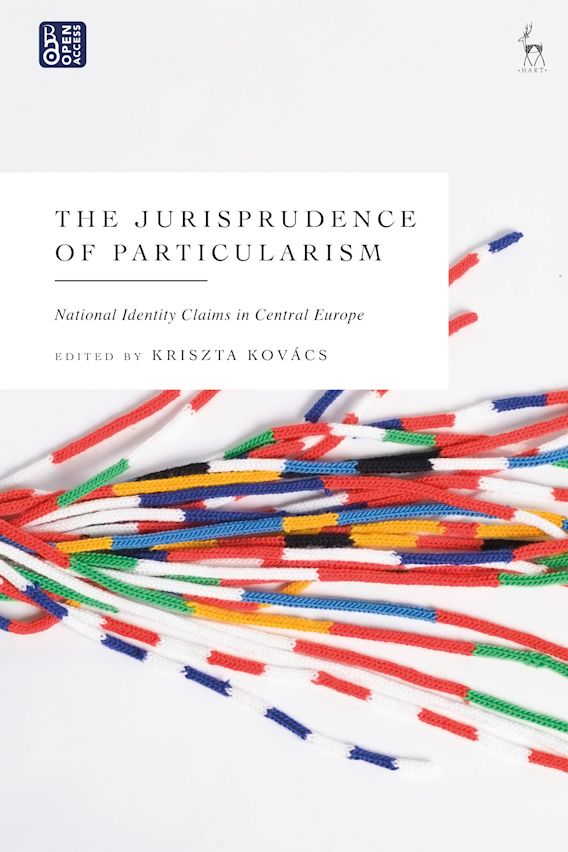
This much timely and thought-provoking edited collection by Kriszta Kovács, Senior Fellow at the WZB Center for Global Constitutionalism, shines a light on a striking paradox – namely, how V4 countries (Poland, Hungary, Chechia, and Slovakia), which were committed to embracing democratic values following the end of communism, have recently been using the notion of ‘national identity’ enshrined in Article 4(2) TEU to challenge EU’s very values. The book helpfully reminds the reader that the concept of ‘national identity’ appeared in EU law following the Lisbon Treaty. However, the principle was quickly weaponised by V4 governments and courts, especially in the aftermath of the infamous 2009 Lisbon judgement by the German Federal Constitutional Court – the book refers to the peculiar ways of interpreting the principles of ‘constitutional identity’ and ‘national identity’ in this context as ‘the jurisprudence of particularism’ (p 5). More specifically, in light of this practice, the book seeks to evaluate if ‘constitutional identity’ and ‘national identity’ are intrinsically flawed as concepts or merely ‘applied in problematic ways’ in V4 jurisdictions (p 3). Based on the rich analysis in the contributions in this volume, one is inclined to conclude the latter.
This edited collection follows a classic structure – it comprises of a detailed introduction as well as eight chapters divided into three semantic parts. The first part is dedicated to justifying ‘constitutional identity’ as a legal concept. The second part showcases the specifics of invoking ‘national identity’ in V4 countries. The third part looks for solutions to the challenge(s) dealt by V4 countries at the EU level.
The book has numerous strengths. It clearly builds on Kriszta Kovács’ earlier work dedicated to constitutional particularism and reaffirms her intellectual passion for the subject (see, for instance, here and here). It also informs a current debate (see, for example, Julian Scholtes, The Abuse of Constitutional Identity in the European Union (OUP 2023)). All contributions show commitment to a rigorous academic standard. It is worth commending the editor for having gathered authors of diverse backgrounds and expertise together. Moreover, she seems to have carefully thought about the necessary balance of points of view and equality of opportunity because contributors range from leading authorities to early career researchers. I was also intrigued to discover in the ‘Acknowledgements’ section that the editor had conducted interviews with other jurists for this project. This shows that the editor was willing to take an extra step to provide unique insights for the reader on a fuzzy, yet technical topic.
To avoid repeating the editorial synopsis and considering that I was asked to review the book for a venue specialised in comparative law, I will only mention the features of each chapter that I believe may be more interesting and/or useful for comparatists. Having said that, the main target group of this otherwise excellent book seems to be constitutional and EU lawyers with some interest in comparisons rather than comparatists per se.
The eloquent introduction is a must-read for those who are not well acquainted with the idiosyncrasies of recent constitutional practice in V4 countries. Beyond explaining in details the characteristics of the jurisprudence of particularism in these jurisdictions, it makes important clarifications about the definitions embraced by the contributors in the book – for instance, it specifies that the authors embrace the view that ‘constitutional identity’ is distinct from ‘national identity’ (p 12). The editor recognises that the relationship between the two concepts is complex and subject to debate, but opines that ‘[c]onstitutional identity… defined as entailing the various understandings of the protection of human rights, democracy, and the rule of law, can automatically be recognised as national identity… [whereas] not all national identities can be recognised as constitutional identities even if they are in some form enshrined in the domestic constitution’ (p 15).
Gary Jeffrey Jacobsohn’s chapter, which follows the introduction, is a compelling case study of the peculiar ways in which legal ideas cross borders and gain a more nuanced meaning, even though it does not explicitly refer to literature on legal transfers – namely, Professor Jacobsohn explains with much attention to doctrinal details how and why efforts to build constitutional barriers against threats to the judicially affirmed constitutional identity in Germany have paved the way for abuses of national identity claims in V4 countries. Monika Polzin’s chapter, which explains how the ‘vague’ and ‘glamorous’ doctrine of ‘constitutional identity’ came to be in German law in order to draw conclusions about how one might distinguish between its misuses and legitimate uses, may be invaluable for those with a flair for legal history (p 58).
The subsequent four chapters are essentially elaborate country reports highlighting the specific uses and misuses of the doctrine of constitutional identity in V4 jurisdictions. While they are not comparative at their core (even though they refer to developments in other countries on occasion), they may be used as toolboxes by comparatists, especially by those who do not speak the languages of the V4. Katarína Šipulová and Max Steuer argue that constitutional identity ‘has not played a central role’ for the Slovak Constitutional Court (p 83) and shed light on why this court has been reluctant to engage with the concept. Miluše Kindlová contends that the Czech Constitutional Court ‘does not strongly subscribe to the idea of particularism’, while also recognising that the court has developed an impressive arsenal of instruments that can be used to assert it (p 109). In a riveting chapter dedicated to the misuse of ‘constitutional identity’ by the (captured) Polish Constitutional Tribunal, Michał Ziółkowski concludes that ‘the backsliding of constitutional democracy in Poland has shown that almost every concept of constitutional law… can be reversed and used in an abusive way’ (p 147). Kriszta Kovács explains how the Hungarian Constitution of 2011 has introduced an ethnocultural national identity grounded in historical myths which is inconsistent with universal constitutional values. As the (captured) Hungarian Constitutional Court has rubber-stamped this identity in its case law, she calls for a reconstruction of Hungarian constitutional identity.
The last two chapters may prove helpful to those pondering the questions and perils of harmonisation of law, especially at the EU level. Mattias Kumm provides a conceptual framework for analysing constitutional identity in relation to Article 4(2) TEU and concludes that there is space, albeit limited, for genuine particularism. In turn, Susanne Baer, Kriszta Kovács and Maya Vogel remind us of the importance of constitutionalism based on the rule of law as well as what truly lurks behind the misuse of particularism in illiberal democracies. With an eye to the future, the authors explore the available solutions to the challenge posed by particularism in the V4.
Considering the book is written in English and targets a diverse audience that is inevitably influenced by its native legal system(s), one recommendation that can be made about a future edition of this book is to be more culturally sensitive when it comes to the definitions of terms. Already the title is somewhat misleading because in the common law ‘jurisprudence’ is usually treated as a synonym of ‘legal theory’. By contrast, the book mostly focuses on case law and doctrine. To this end, a definition of the term ‘jurisprudence’ itself in the introduction may prove useful.
Moreover, from the perspective of those who research other former-communist countries in the EU, some claims in the introduction may seem exaggerated or insufficiently substantiated. For instance, it is argued that the V4 countries have exhibited ‘the most visible signs of exclusionary nationalism in the EU’ (p 3), without pointing to a reference or relying on substantive comparative research between V4 and other EU member states to justify this statement. Relatedly, the claim that it is ‘unique’ about V4 countries that ‘constitutional judiciaries have played a determining role in invoking the concept of constitutional or national identity’ (p 4) can be challenged by using examples from non-V4 countries. Both assertions can easily be contested by relying on examples from Bulgaria. For instance, Bulgaria’s Constitutional Court delivered a judgement declaring the Istanbul Convention incompatible with the country’s constitution, which was subsequently followed by a judgement clarifying the notion of sex in the constitution based on religious arguments, including an overview of the role of Bulgaria’s church in preserving Bulgaria’s national identity and with the pretence that the understanding of sex as solely a biological category is an emanation of Bulgaria’s ‘national constitutional identity’ (see here and here). Both resulted in controversial judgements by other courts, including the Supreme Court of Cassation, because they are binding and irreversible.
Overall, however, I wholeheartedly recommend this book to anyone fascinated with the constitutional laws of Central Europe as well as to those studying the rule of law backsliding in the EU. Many chapters of this book may provide food for thought for scholars specialised in comparative law and inform their research, too.
Posted by Dr Radosveta Vassileva, Middlesex University
Suggested citation, R Vassileva, ‘Review of Kriszta Kovács (ed), The Jurisprudence of Particularism: National Identity Claims in Central Europe (Bloomsbury Publishing 2023), ISBN: 9781509960125′, BACL Blog, available at https://british-association-comparative-law.org/2023/12/15/kriszta-kovacs-ed-the-jurisprudence-of-particularism-national-identity-claims-in-central-europe-bloomsbury-publishing-2023-isbn-9781509960125-reviewed-by-radosveta-vassileva/
 British Association of Comparative Law