
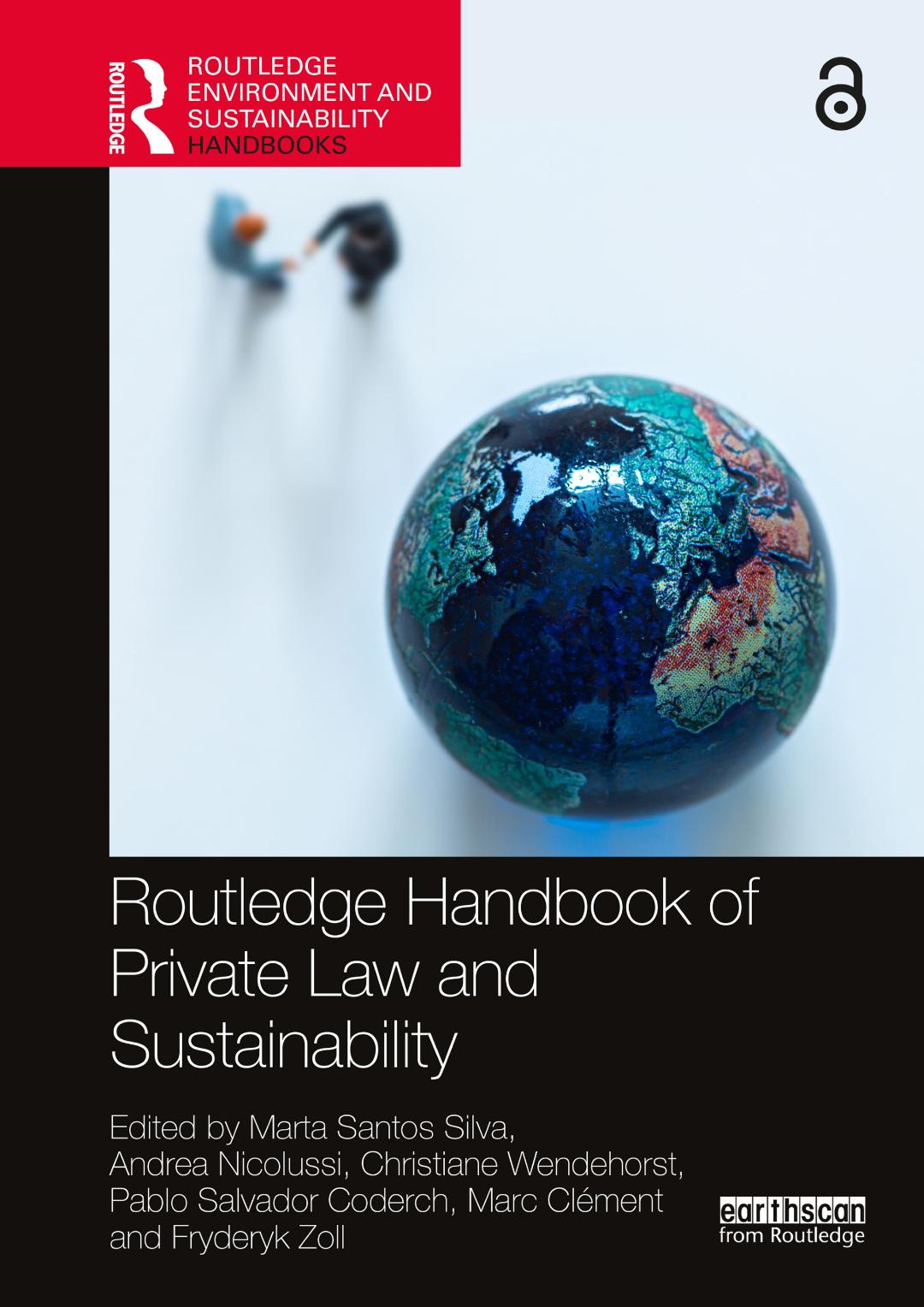
The Routledge Handbook of Private Law and Sustainability, edited by Marta Santos Silva, Andrea Nicolussi, Christiane Wendehorst, Pablo Salvador Coderch, Marc Clément and Fryderyk Zoll, explores how private law can play a critical role in fostering a sustainable future. With contributions from leading scholars, the book offers cutting-edge discussions, case studies, and theoretical frameworks addressing the urgent need for legal systems to adapt and tackle the complex environmental crises we face. Given the increasing global focus on sustainability, this volume is an invaluable resource for scholars, policymakers, and practitioners seeking insights into how private law can contribute to achieving sustainability goals.
Sustainability has been at the forefront of international legal discourse, especially since the adoption of the United Nations’ Sustainable Development Goals (SDGs) in 2015 and the European Green Deal ln 2019. These initiatives have set ambitious goals for climate neutrality and environmental protection. However, despite considerable political and economic efforts, there remains a significant gap in applying legal frameworks, particularly within private law, to tackle sustainability challenges. The Routledge Handbook aims to bridge this gap by offering an in-depth analysis of the intersection between private law and environmental sustainability.
Alongside my fellow co-editors, I have curated a diverse range of contributions that provide a comprehensive and comparative exploration of how private law frameworks are evolving to address the challenges posed by climate change, resource depletion, and biodiversity loss. The book is divided into six parts, each reflecting the multidimensional nature of the subject. Through a comparative approach, it highlights how different legal systems across political, economic, and cultural contexts are adapting to the sustainability imperative, offering valuable insights for scholars and practitioners in the field.
Greening Private Law and the Law of Obligations
Part 1, Greening Private Law and in Particular the Law of Obligations, sets the stage by examining how traditional legal principles, such as contracts, torts, and obligations, are being adapted to better reflect environmental concerns. Barbara Pozzo’s chapter, fully available in the preview pdf, introduces the idea of private law hybridisation according to which established legal instruments are evolving to accommodate sustainability principles. This transformation is crucial as private law has traditionally been seen as protecting individual rights, often overlooking the broader environmental implications of legal transactions.
Dario Hug’s contribution is notable for its exploration of how contract law can integrate sustainability principles, suggesting that adopting an eco-literate interpretation could foster more environmentally responsible business practices. Rosa M. Garcia-Teruel further emphasises the role of civil law in promoting sustainable energy practices, particularly within the residential rental market. The section also includes valuable comparative insights, such as Radosveta Vassileva’s analysis of the challenges faced by post-communist countries like Bulgaria in incorporating sustainability into their private law systems.
Part 1 concludes with Candida Leone’s examination of the integration of sustainability into private law teaching, arguing that law courses should contribute to educating future lawyers about the importance of sustainability in legal practice.
Fostering Environmental Protection through Consumer Law
Part 2, Fostering Environmental Protection through Consumer Law, shifts focus to one of the most immediate and impactful areas of legal reform: consumer law. Given that consumer behaviour has a significant influence on resource use, waste generation, and the broader environmental footprint, consumer law is a key tool in promoting sustainable practices.
Several contributions critically assess the EU’s consumer protection framework, evaluating its capacity to encourage more sustainable consumption patterns. Fryderyk Zoll, Katarzyna Południak-Gierz, Wojciech Bańczyk, and Maciej Bujalski’s analysis of the EU’s Proposal for a Directive on Common Rules Promoting the Repair of Goods highlights the need to shift from promoting the disposal of goods to fostering a circular economy through repair and reuse. This is further supported by Maria Miguel Oliveira da Silva and Jorge Morais Carvalho’s comparative analysis of Directive (EU) 2019/771 and its role in promoting sustainable consumption within the European legal framework.
Consumer responsibility also plays a central role in this section, as demonstrated by Lucila de Almeida and Fabrizio Esposito’s exploration of how consumer law can encourage individuals to consider the environmental impact of their purchasing decisions, rather than focusing solely on short-term convenience. While the EU has made significant progress in integrating sustainability into consumer protection, challenges remain in aligning regulatory frameworks with sustainability objectives.
The section also includes Mireia Artigot Golobardes’ comparative study, offering insights into how different jurisdictions foster sustainable consumption through consumer law. Petra Weingerl’s chapter on Slovenian private law and its treatment of durable goods provides an interesting perspective for comparative law scholars examining how various legal systems approach sustainability in consumer goods regulation.
Coordinating Public and Private Sustainability Law in Europe
Part 3, Coordinating Public and Private Sustainability Law in Europe, explores the intricate relationship between public and private law in the context of environmental protection. Public law frameworks, such as the European Green Deal, set ambitious environmental goals, while private law plays a critical role in ensuring that these goals are implemented within the market and society.
Contributions from Guido Alpa and Roberta Calvano, as well as Verica Trstenjak’s analysis of the CJEU’s role, explore how the dialogue between national courts and the CJEU has helped shape sustainability objectives across various sectors. This judicial interplay is vital in driving the implementation of sustainability measures within private law, ensuring that legal frameworks continue to evolve alongside public regulatory standards.
Kristina Siig’s chapter on the use of contract-based lex mercatoria in ship recycling, and Maria Regina Redinha and Maria Raquel Guimarães’s exploration of the subjective right to a stable climate in Portuguese law, both highlight the complex relationship between private law and public (international) law in regulating sustainability. These contributions are particularly valuable for scholars interested in the intersection of public and private law in environmental governance.
Conciliating Property Rights and Environmental Protection
In Part 4, Conciliating Property Rights and Environmental Protection, the book examines the role of property law in managing natural resources and shaping land use in ways that support or undermine sustainability goals. Björn Hoops argues that traditional property law must be reformed to include ecological considerations, emphasising that property ownership should reflect social and environmental responsibilities. Francesco Zecchin’s chapter further explores how Italian property law is evolving to incorporate ecological principles, highlighting an emerging paradigm shift in property rights.
The section also includes contributions from Miha Juhart and Tatjana Josipović who explore the constitutional and public law constraints on property rights, particularly in relation to environmental protection. Juhart’s focus on Slovenian forest ownership provides an interesting example of how public law considerations intersect with private law in the context of sustainability.
Green Economy Transition: Sustainable Consumption and Production
Part 5, Green Economy Transition: Sustainable Consumption and Production, explores the transition to a more sustainable economic model, focusing on how private law can drive sustainable production and consumption practices. Several chapters in this section discuss how legal frameworks can incentivise businesses to adopt eco-design principles, reduce consumption, and tackle issues like planned obsolescence.
Denis Philippe’s analysis of legal remedies for combating planned obsolescence in the EU highlights the challenges faced by legal systems in addressing consumer culture driven by disposability. Janja Hojnik’s exploration of the sustainability potential of the servitisation economy illustrates how business models based on services rather than ownership can contribute to reducing consumption and extending product lifespans.
Comparative law scholars will find Victor Mehnert and Hans-W. Micklitz’s chapter on eco-design and consumer sales law particularly valuable. It provides a comparative analysis of how different jurisdictions are integrating eco-design standards into private contracts and consumer sales regulations. Tomàs Gabriel García-Micó’s and my chapter on green sludge in distance sales contracts brings forward an innovative solution to reduce the environmental harm caused by excessive returns, encouraging more responsible consumer behavior.
Dealing with Climate Justice and Corporate Responsibility
The final section, Dealing with Climate Justice and Corporate Responsibility, examines the growing role of corporate responsibility in promoting sustainability. Hugo-Maria Schally’s chapter on the EU Green Deal provides an in-depth analysis of how European companies are required to integrate sustainability into their operations, highlighting the legal obligations businesses face in response to climate change.
Ralf Michaels and Samuel Zeh’s exploration of transnational climate change litigation in private international law is particularly noteworthy as it examines how corporations can be held accountable for their environmental impact across borders. Other contributions, such as Sandra Passinhas’s advocacy for contract rescission as a remedy for consumers misled by commercial practices, emphasise the need for private law to support sustainable consumption patterns.
Iain MacNeil and Irene-marié Esser’s discussion of corporate purpose as a legal principle in promoting sustainability addresses critical questions about whose interests corporate governance should serve and how to integrate sustainability into decision-making. Carlos Gómez Ligüerre and Lela Mélon’s examination of online platforms and the imposition of sustainability obligations on them reflects the increasing recognition of their role as gatekeepers in the digital economy.
Jakub Błażej Zwierzchowski and Ewa Rott-Pietrzyk’s chapter on sustainability clauses in global value chain contracts highlights how business practices can support the UN Sustainable Development Goals, while also addressing issues of unfair practices and human rights. Rebecca Ravalli’s exploration of the EU’s Corporate Sustainability Due Diligence Directive offers an in-depth analysis of how contract law can ensure compliance with sustainability requirements in global supply chains.
Marc Clément’s chapter on environmental litigation provides a fitting conclusion to the book, exploring the complex boundaries between public and private law in environmental governance. The chapter highlights the challenges of defining the scope of legal frameworks and underscores the dynamic interplay between the two areas.
Conclusion
The Routledge Handbook of Private Law and Sustainability is an essential resource for anyone interested in the intersection of law and sustainability. Through its comparative approach, the volume provides valuable insights into how private law can contribute to global sustainability efforts. The book offers a call to action for legal scholars, policymakers, and practitioners to rethink and reform legal frameworks in response to the growing environmental crisis, with a particular focus on how private law can drive meaningful change.
Posted by Marta Santos Silva, Research Centre for Justice and Governance at the University of Minho, Portugal, marta.santossilva[at]direito.uminho.pt
 British Association of Comparative Law
1 Comment
Comments are closed.