
Introduction
The field of comparative constitutional law has historically developed as an intellectual project largely rooted in, and oriented around, the Global North. This sustained emphasis on a limited set of “canonical” jurisdictions in Europe and North America has shaped the dominant theoretical frameworks and comparative models of the discipline, which are often derived from a relatively narrow range of case studies. Although the past two decades have seen a gradual expansion of the field to include jurisdictions such as India and South Africa, sustained comparative engagement with so-called “non-standard” jurisdictions remains relatively limited. Yet the governance challenges of an increasingly globalised and interconnected world call for imaginative approaches and transnational responses — ones that can only emerge from genuinely comparative and deeply contextual analysis. Our four-volume series Asian Comparative Constitutional Law seeks to redress the field’s traditional imbalance by significantly expanding its empirical and analytical horizons. It provides an authoritative examination of four central themes in comparative constitutional law across Asian jurisdictions: constitution making (Volume 1), constitutional amendments (Volume 2), constitutional structure (Volume 3) and constitutional rights (volume 4, in progress).
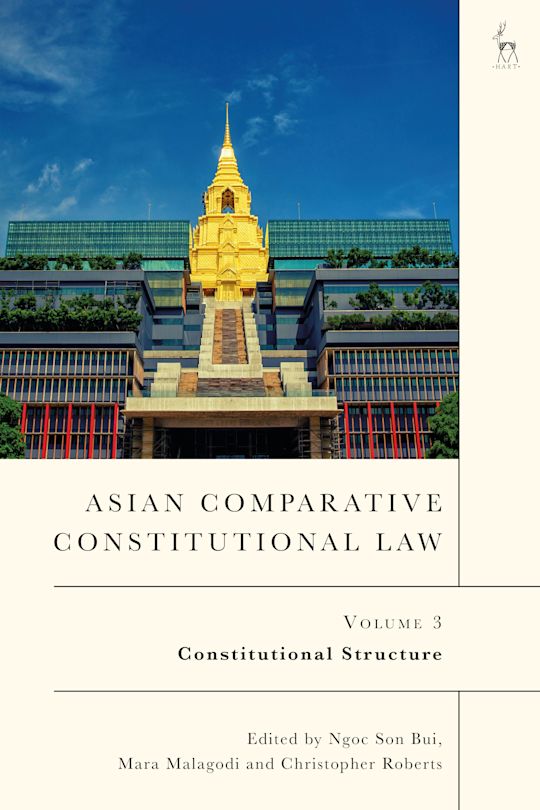
As part of this broader project, Asian Comparative Constitutional Law: Constitutional Structures offers a comprehensive and critical survey of constitutional arrangements across eighteen Asian jurisdictions. Each chapter focuses on a single jurisdiction, mapping its overarching constitutional architecture and framework of government, and considering how these rules and structures operate in practice. By applying a common template of research questions to each case study, the volume enables systematic comparison while remaining attentive to the specific historical, political, and institutional contexts in which each constitutional system is embedded. The jurisdictions covered in the volume span three Asian sub-regions: East Asia (Japan, Mongolia, China, Taiwan, Hong Kong, Macau, South Korea, North Korea), Southeast Asia (Malaysia, Singapore, Myanmar, Philippines, Indonesia, Thailand, Laos), and South Asia (Pakistan, Bangladesh, Sri Lanka). Crucially, the comparative studies span a spectrum of regime types, encompassing constitutional frameworks operating under both democratic and authoritarian conditions, to explore the ways in which institutional design, legal norms, and governance practices adapt to different political contexts and shape the functioning of state power. Most centrally, the volume brings out comparative insights relating to six key themes: the configuration of the doctrine of separation of powers; the role of constitutional courts; the functions of fourth branch institutions; the constitutional framing of political parties; the relationship between identity politics and territorial governance; and the constitutional position of the military.
Comparative Insights
One of the strengths of a volume such as this one, and the numerous nuanced and insightful chapters that make it up, is the extent to which the different authors make clear that there is no simple approach or formula through which the basic structure of a state can be easily or comprehensively understood. The diversity of constitutional arrangements in Asia reflects the complex historical and political trajectories of these jurisdictions. In many cases, histories of colonisation, in some cases more extensive and in others relatively brief, had a major impact on the systems in place today. This impact often remains direct, in the sense that the states considered have political systems that borrow numerous aspects from their former colonial powers. In other cases, a negative dialectic can be observed, in which states have rebelled against one or more facets of their colonial legacy. Adding to the complexity, a number of states have taken inspiration from other aspects of comparative practice, borrowing elements of constitutional design that seemed desirable at one moment in time or another. In other cases, states have drawn on older indigenous traditions to nuance or add additional or alternative elements to their basic government structures.
In some cases, moreover, the influence of global norms can be clearly observed across states. For instance, there has been strong international support over the time period considered — roughly, the latter portion of the twentieth century through the present — in favour of judicial review (pertaining to legislation, executive or administrative action, and/or rights violation), and many of the jurisdictions considered currently have courts that exercise judicial review powers. Not all states have been equally open to such international pressures, of course. It remains to be seen, moreover, whether international pressures will continue in the same directions they have generally flowed in the post-World War II decades in future, or whether different norms will become prominent.
While the modes and moments of influence vary, the constitutions considered are all strongly marked by early modern and modern developments in political thought. Thus, it is hard to find a jurisdiction in which the principles of constitutional supremacy, the separation of powers and judicial independence are not at least given a nod in theory. At the same time, contrary traditions that also have global legacies — including a belief in the necessity of a strong executive as well as resistance to an overly-empowered judiciary — can be seen operating as well. On top of this, the legacy of communist thought likely continues to play a stronger role in Asia than in any other region of the world. Moreover, a contextual approach to constitutional comparison also highlights the crucial fact that Asian jurisdictions have contended with the issue of governing highly diverse societies marred by profound intersectional inequalities. Thus, both identity and class politics have historically represented major influences on constitutional design and practice across the continent. In this context, the politics of recognition alongside the politics of redistribution has clearly shaped the territorial organisation of state power, linked to the aims of avoiding secession and defusing civil conflict, with more or less success across contexts.
As the chapters in the volume also make clear, no simple line of causality can be drawn between different fundamental systems of government and political outcomes in practice. Perhaps most notably, while the jurisdictions considered have opted for numerous different state design options, many have tended towards strong executives in practice. In this respect, the degree of constitutionalisation of the military is a particularly important feature of constitutional design and praxis that ought to be considered in the comparative analysis of these case studies. In some cases, executive dominance has led to instability; in other instances, relatively consolidated systems have been able to maintain legitimacy and stability over extended periods of time. While it is beyond the capacity and purpose of the volume to reflect on the reasons why this has been the case, the collected chapters help pave the way towards further work in this area, by laying out empirical issues in need of further explanation.
As all of this makes clear, no simple summary can be presented of developments and the current state of play relative to constitutional structures in Asia. Indeed, outlining the broad contours of developments in this area has presented each of the authors in the volume with an extremely challenging task, one to which they might have responded in several different manners, and doubtless at much greater length, had they had the opportunity to do so. Nonetheless, pulling all these accounts together allows for wide-angled perspectives to be developed. Relative to basic constitutional structures, what are some of the key insights of the chapters collected herein?
Contributions
Overall, the volume seeks to make three distinctive contributions to the comparative constitutional law literature.
First, it aims to fill a significant jurisdictional gap in the literature. The scholarship of comparative constitutional law in Asia is growing, but tends to focus on big and developed countries, such as India, China, Japan, South Korea, and Taiwan. In this context, some Asian jurisdictions continue to remain heavily underrepresented in the field of comparative constitutional law. The volume features a significant number of “non-standard” jurisdictions that have received very little comparative attention, such as North Korea, Mongolia, Macau, Laos, and Sri Lanka.
Second, the volume also contributes to filling a critical methodological gap. Each chapter combines the analysis of formal constitutional rules and structures with extra-legal contextual factors such as political, economic, and socio-cultural factors to encompass both formal institutional design and socio-legal realities. The template adopted reflects this approach through a set of formal and functional questions. Formal questions focus on constitutional design, i.e. how the constitution defines and regulates the frame of government in terms of legislative-executive relations, the court system, forms of constitutional review (including specialist, ordinary judicial review, and non-judicial institutions of constitutional review), central-local relations and federalism, the role of the political parties, the role of the military, and independent institutions (such as audit, election, and anti-corruption institutions). Functional questions concentrate on constitutional praxis, i.e. how the constitutional framework and its various institutional components work in practice, and how legal and extra-legal factors influence the operation of the constitutional machinery. The factors include contextual factors such as politics, local culture, ethnic diversity, social structure, etc. Thus, the volume integrates functionalism and contextualism. The template reflects common functional questions facing constitutional structures in the region. This suggests a certain level of constitutional convergence. For example, constitutional judicial review has been adopted in most jurisdictions. At the same time, the volume is sensitive to the contextual factors that shape the functions of constitutional structures, which generates constitutional divergence. To illustrate, Hong Kong and Macau have the same institutional design of judicial review, but the practice of judicial review in Hong Kong is much more active than in Macau due to the divided political context in the former.
Third, the volume aims to make a substantive contribution by drawing crucial comparative lessons that can advance the field of comparative constitutional law. The volume’s mapping of constitutional structures moves beyond the three traditional branches (executive, legislature, and judiciary), and also includes fourth branch institutions, non-state actors, the military, and political parties.
Implications for Future Study
At the formal level of constitutional design, the Asian jurisdictions studied in the volume involve issues of constitutional structure that are common in the field of comparative constitutional law. Although many Asian constitutions exhibit a degree of formal convergence, however, their practical operation often reveals significant divergence. The contextual factors that shape these varied constitutional structures warrant closer examination. In particular, four contextual dimensions merit further scholarly attention: (1) social and cultural diversity; (2) the legacy of colonialism; (3) the influence of authoritarian governance; and (4) patterns of economic development. Understanding how these factors interact is essential for a nuanced comparative analysis of constitutional design and practice across the Asian region, and beyond.
First, the ways in which ethnic, cultural, and religious diversity influence the design and functioning of constitutional structures in Asia warrant further study. Variations in social composition — such as ethnic heterogeneity or intergroup conflict — can help explain choices between presidential and parliamentary systems, or between unitary and federal arrangements. Jurisdictions that are more divided along socio-cultural political cleavages often adopt institutional configurations aimed at managing or mitigating these divisions, which in turn accounts for significant variation in constitutional structures across the region. While these themes have been central to comparative constitutional inquiry, they continue to shape constitutional politics in Asia and require sustained critical analysis.
Second, colonialism has greatly influenced the configuration of postcolonial constitutional frameworks across Asia. Most Asian jurisdictions underwent colonisation under different Western powers, and this plurality of colonial experiences has contributed to the region’s diverse constitutional structures. In fact, colonial rule has influenced both the initial design and the subsequent functioning of constitutions in post-independence Asian states. Many jurisdictions continue to reflect the institutional frameworks of their former colonisers: a modified Westminster model continues to prevail across former British colonies in Southeast and South Asia, while the Philippines have incorporated elements of the U.S. presidential system, for instance. The enduring impact of colonial legacies on constitutional design and praxis in Asia remains an important area for further scholarly investigation as the configuration of state sovereignty in both its internal and external dimensions remains a fraught and embattled concept.
The third contextual factor is authoritarianism. While some Asian jurisdictions have progressively established relatively stable democratic systems, a significant number of constitutional structures in the region continue to operate under authoritarian conditions. Importantly, authoritarianism in Asia is far from monolithic: it manifests in multiple forms, including personalist regimes, military rule, and single-party dominance. These variations raise important questions about the relationship between regime type and constitutional design. For example, how do different forms of authoritarianism shape the organisation of executive, legislative, and judicial institutions? How do they influence the balance of power, institutional resilience, and the enforcement of constitutional norms? Addressing these questions is crucial for a deeper understanding of the diversity and functionality of constitutional structures across Asia, and for situating them within broader comparative debates on authoritarian governance. In this respect, the constitutionalisation of the armed forces and their successful control by civilian governments have been key issues of constitutional design and praxis across Asia. Given the central role that the armed forces have played and continue to play in so many Asian jurisdictions, alongside the exponential escalation of armed conflicts world-wide, the comparative study of the constitutional treatment of the military requires further sustained study and comparative analysis.
Finally, the relationship between constitutional structures and economic development in Asia needs closer examination. The region encompasses a wide spectrum of economic contexts, from highly developed economies to emerging and less-developed states, offering a rich empirical landscape for comparative analysis. Insights from literature exploring constitutional structures alongside economic development suggests that institutional design can have significant causal effects on economic performance, influencing laws and policies pertaining to property rights, regulatory frameworks, and the rule of law more broadly. Conversely, patterns of economic development may also shape constitutional structures, as states adapt their institutional frameworks to support growth, manage inequality, or respond to social and political pressures. Asia, the world’s most populated and economically largest region, provides an essentialcontext in which to explore the dynamic and intimately intertwined relationship between constitutional design and economic outcomes, revealing how structural choices both reflect and influence the trajectories of social, economic and human development. The study of comparative constitutional law with a focus on economic development is all the more important in the context of environmental degradation and rising competition for natural resources, as institutional choices shape not only growth trajectories but also the regulation, allocation, and sustainable management of critical ecological and resource-based assets.
(Posted by Ngoc Son Bui, Mara Malagodi, And Christopher Roberts)


1 Comment
Comments are closed.