

Introduction
How is patrimonial solidarity between spouses conceived and operationalised in continental European jurisdictions? In most systems, the property relations between spouses are governed by a matrimonial property regime. The default regime, which is applicable in the absence of a marital agreement, usually ensures that the property accumulated during the marriage (the ‘matrimonial property’) is equally shared upon divorce. Although this outcome appears straightforward, continental European jurisdictions reach it through markedly different pathways. Some adopt community‑based regimes, which create a community of property during the marriage that will later be divided upon divorce, as is the case in France, Belgium, and the Netherlands. Others maintain separation‑based regimes, which preserve separate estates throughout the marriage but impose a deferred sharing mechanism when the marriage ends, a structure found in Germany, Switzerland, Austria, and Norway.
These two types of matrimonial property regimes, the community-based regimes and the separation-based regimes, are traditionally regarded as having diametrically opposed starting points and are often believed to be unsuitable for in‑depth comparisons. However, it is worth questioning whether this longstanding assumption truly reflects how these matrimonial property regimes operate in practice. A deeper and more systematic comparison reveal that the structural differences between community-based and separation-based regimes do not preclude a meaningful analysis, and that both types of regimes express solidarity in ways that are more similar than is usually assumed. Such a comparison also offers an opportunity to examine whether community‑based regimes genuinely embody a higher degree of solidarity in their detailed operations, a presumption often made on the basis of their general legal frameworks.
In Marriage, Property and Solidarity in Europe. A Comparative Legal Analysis (Elgar, 2025), these questions are answered through an extensive comparative study of ten matrimonial property regimes from seven continental European jurisdictions: Austria, Belgium, France, Germany, the Netherlands, Norway, and Switzerland. In addition, the Franco‑German community of accrued gains regime and the regimes proposed by the Commission on European Family Law in its Principles of European Family Law Regarding Property Relations Between Spouses (2013) are also included. A central component of the study is the use of the numerical comparative method. This blogpost outlines both the comparative methodology and the key research findings.
The comparative methodology
Functional comparative analysis based on ten problem statements (‘parameters’)
To better understand how solidarity is concretely expressed in the analysed matrimonial property regimes, first, a series of problem statements are selected to which each regime must provide a solution. Each possible solution to a given problem expresses a specific degree of solidarity. The book employs ten such problem statements, referred to as ‘parameters’, which address both the functioning of the regime during the marriage and the mechanisms of property sharing upon divorce. The parameters address, for example, the protection of the family home, the regulation of debts, the content of the matrimonial property, and the method of property sharing. For each parameter, the thirteen analysed regimes are grouped according to the type of solution they provide, rather than being discussed in juxtaposition, i.e., jurisdiction by jurisdiction.
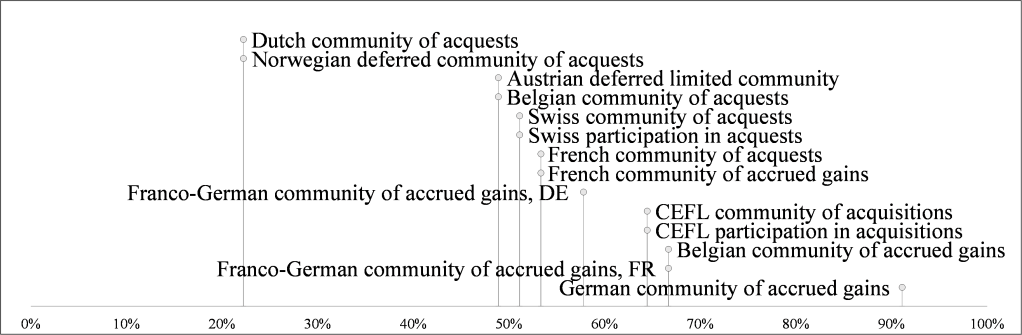
A simple example illustrates how the analysis is structured around these parameters. One parameter concerns the question of which types of income are included in the matrimonial property and therefore shared upon divorce. The inclusion of a broader range of income categories reflects a higher level of solidarity between the spouses. As part of this parameter, four specific elements are considered: income related to profit (such as a director bonus), income with a supplementary or replacement function (such as a severance pay), income from non-matrimonial property (such as rental income from inherited real estate), and income with a specific function (such as compensation for immaterial damages). For instance, regarding the question of whether income derived from non‑matrimonial property is included in the matrimonial property, three possible solutions are identified: (1) such income is never included; (2) such income is included only under specific conditions; (3) such income is always included. The Dutch community of acquests regime and the Norwegian deferred community of acquests regime follow the first solution; the Austrian deferred limited community regime follows the second; all other regimes follow the third.
By mapping solutions in this manner across all ten main parameters and the 57 sub‑elements they comprise, it becomes possible to identify, with considerable precision, the instances in which each regime expresses high, low, or conditional solidarity. Solidarity thus emerges not as a vague or binary concept, but as a multi‑layered and nuanced phenomenon.
Quantifying solutions: the numerical comparative method
The second methodological step involves a further operationalisation of all theoretical findings through the numerical comparative method. Building on the framework first thoroughly discussed by Mathias Siems, each solution to a given parameter or sub-element is assigned a score from 0 to N (with N equal to the number of possible solutions). Higher scores indicate that a given solution represents a higher degree of solidarity, whereas lower scores represent a lower degree of solidarity. Returning to the earlier example, the solution through which income from non‑matrimonial property is never included in the matrimonial property receives the lowest possible score, while the solution that always includes such income receives the highest. On this point, therefore, the Dutch and Norwegian regimes reflect the lowest degree of solidarity.
These individual scores are aggregated into overall scores for each regime at the end of the analysis of each parameter. The results are then presented visually in tables and plotted along a ‘continuum of solidarity’. To illustrate, the previously discussed parameter on the question of which types of income are included in the matrimonial property, results in the following continuum.
To provide an overarching view, a global continuum summarises the scores of all analysed parameters and regimes. This systematic quantification produces several noteworthy insights. Among the regimes studied, the data indicate that the Belgian and Swiss community of acquests regimes provided spouses with the highest overall levels of solidarity. More broadly, the results demonstrate that solidarity can be operationalised and quantified without sacrificing complexity.
The use of the numerical comparative method within family law, and even private law more broadly, is certainly unusual. Methodological guidance in existing scholarship is limited, and concrete practical examples are rare. The book therefore offers detailed guidance for scholars wishing to adopt or refine the numerical comparative method. While acknowledging the methodological debates surrounding numerical comparative law, as well as the limitations and relative nature of the approach employed, the present study may illustrate the potential benefits of quantification in comparative law, within family and private law and beyond. As such, although valid arguments exist both for and against the numerical comparative method, the book may contribute to ongoing debates and serve as a catalyst for further academic discussion.
How solidarity is operationalised across matrimonial property regimes: three key insights
Through the methodology described above, it is possible to answer the central research questions. Despite the frequently asserted dichotomy between community‑based and separation‑based regimes, and the widespread view that these models are conceptually too incompatible to compare, the book demonstrates that they can in fact be compared in a systematic and meaningful manner. By analysing the two types of regimes together rather than in opposition, three novel insights emerge.
The first key insight is that both types of matrimonial property regimes are capable of generating sufficient solidarity between the spouses. A regime does not need to establish a community of property at the start of the marriage to achieve fair outcomes, although such a system continues to operate as an indispensable baseline in numerous European jurisdictions. What matters only is that the mechanisms of property division at divorce lead to a fair sharing between the spouses.
The second insight is that, in addressing the same problems, community‑based and separation‑based regimes often provide functionally equivalent solutions even when the legal‑technical routes differ. The comparison thus reveals various similarities between both types of regimes in their detailed operations. Such similarities often remain hidden in traditional scholarship where the focus rests solely on overarching structural distinctions.
The third finding is that, contrary to common assumptions, community‑based regimes do not always express higher degrees of solidarity than separation-based regimes. While the results do confirm that community-based regimes generate more overall solidarity, in many detailed instances, separation‑based regimes do provide more solidaristic solutions. This finding demonstrates that the presumed distinction between the two types of matrimonial property regimes is not entirely supported by a more in-depth analysis.
Conclusion
In conclusion, patrimonial solidarity between spouses is best understood not as an either‑or concept, but as a continuum along which regimes adopt different solutions to shared problems. The use of the numerical comparative method makes this continuum visible by allowing the underlying operations of matrimonial property regimes to be examined in a structured and detailed manner. Across ten parameters and numerous sub‑elements, the study shows that solidarity is measurable, and that such measurements may clarify the nuanced variations present in both community-based and separation-based regimes. What emerges from this analysis is a clearer and more operational understanding of how solidarity is expressed within matrimonial property law and how regimes that appear to be diametrically opposed, may in fact be more comparable than is often assumed.
Hannelore THIJS
(Posted by BACL editor)

