
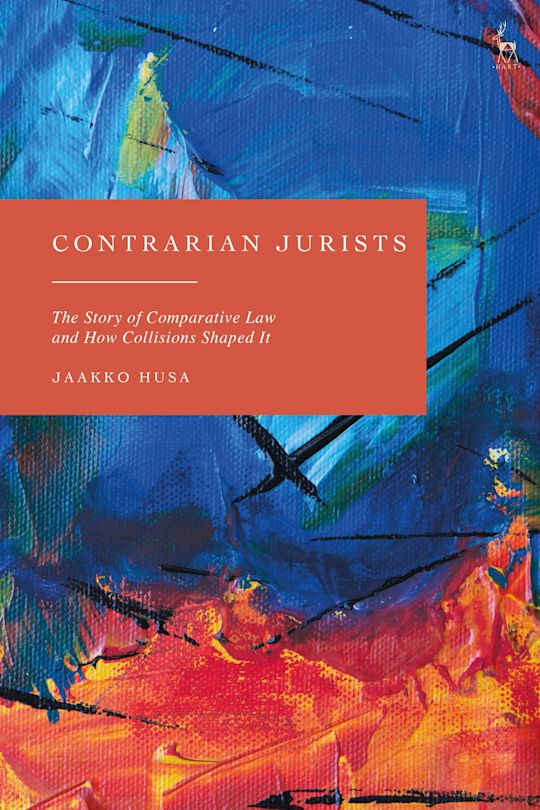
The underlying idea of the book Contrarian Jurists: The Story of Comparative Law and How Collisions Shaped It (Hart Publishing, 2026) is to frame comparative law through the metaphor of ‘collisions’ which are the intellectual confrontations that have shaped the discipline’s evolution since the 1970s. The starting point is a personal observation: comparative law resists a single, one-size-fits-all definition. Far from being – as the saying goes – a fully mature discipline, comparative law continually redefines itself, oscillating between divergent methodologies, goals, and identities. The inbuilt instability has long provoked anxieties about the field’s maturity and produced rich but incoherent scholarship. Essentially, the scholarly contestation is not a symptom of weakness or adolescence, but a force of transformation that has driven comparative law towards pluralism and interdisciplinarity in the last couple of decades.
In my view, there are three general purposes of comparative law: an instrument of learning about law and its contexts, a taxonomic science, and a pragmatic tool for legal harmonisation and reform. These ends coexist with persistent methodological disagreement over what counts as ‘law’, whether comparative study should focus on legal texts or law in action, and how to weigh doctrine in relation to sociological, historical or empirical knowledge. The ambition of the book is to highlight and contextualise a long‑running justification/legitimation discourse among comparatists who often portray their discipline as unfinished business that ought to reach scientific maturity sometime in the future. Rather than lamenting this condition, the book depicts today’s comparative law as the product of contrarian scholarship. As a field, comparative law is depicted as an arena populated by entrepreneurial scholars who prize independence of thought and who deliberately resist disciplinary conformity almost in a kneejerk fashion.
The notion of ‘collision’ is offered as a more flexible and suitable analytic frame than dialectics, paradigms or so-called ‘great debates.’ Dialectical and Kuhnian metaphors imply tidy progression or episodic revolutions leading to more developed science. Instead of applying these frameworks, the story of modern comparative law, by contrast, displays enduring debates that rarely synthesise into settled paradigms or coherent methodologies. ‘Collision’ captures recurring, sometimes subterranean, disputes – talking past one another, institutional rivalries, academic bitterness – and permits an appreciation of both their productive and corrosive effects. Positively, collisions clarify conceptual problems, sharpen arguments, and occasionally (not often though) change orthodoxies. Negatively, they generate entrenched divisions, discourage junior scholars from engaging controversial topics, and produce academic tribalism.
In essence, the book is a mapping exercise. My aim is to describe the intellectual landscape of the field from a non-partisan point of view. A series of major collisions that structure contemporary comparative scholarship is mapped and critically discussed. These include the law‑in‑books versus law‑in‑action divide and the role of legal realism, the debate whether comparative law is best conceived as a method or as an autonomous discipline, and the tension between academic and practical orientations. Also the public–private law divide, which historically structured comparative inquiry but has in recent decades lost potency, is discussed. A further collision addressed takes place between theoretical comparatists, who focus on methodology and epistemology, and self-proclaimed pragmatists who profess to emphasise the practical role of comparative law and its alleged significance for the legal profession.
There are further collisions. Cultural divisions, notably the West versus the Rest, are claimed to underpin macro‑comparative work and animate controversies over legal families, legal orientalism, and decolonisation. Another axis of contestation concerns the specialist country-expert versus the generalist comparatist: different forms of expertise produce distinct comparative practices and evaluations. Functionalism, the supposed dominant strategy of comparative law, remains disputed as ever, and debates over legal transplants reveal contrasting assumptions about law’s social embeddedness and transplantability.
Methodological splits are also examined: the tension between individualising qualitative research and generalising quantitative studies (labelled as the Methodenstreit of our time), and the rise of critical scholarship which interrogates power, colonial legacies, and hidden normative presuppositions in comparative projects. Finally, the book maps the impact of diminished state sovereignty and the growth of transnational and global law, asking whether ‘we are all comparatists now’ (as provocatively claimed by William Twining) as legal orders increasingly overlap and non-state transnational regimes proliferate.
Throughout the book, I insist that collisions are not incidental but constitutive. Collisions have transformed comparative law from an auxiliary discipline into a pluralistic and vibrant, interdisciplinary endeavour of today. The expansion of sources, methods and objects of study, from state law to plural normative orders, from textual exegesis to socio‑legal fieldwork and empirical mapping, reflects broader global changes. Importantly, the book does not promise nor seek to reconcile every dispute. Rather, it aims to trace the major points of contention, address their historical and intellectual roots, and illustrate how they have redirected the field’s intellectual focus.
While comparative law may never attain a single defining paradigm, the multiplicity of approaches and the sustained scholarly collisions have produced a richer, more flexible discipline better equipped to study law in a globalised, legally plural world. Progress in the field, where it occurs, is incremental and uneven. Regardless, the existence of continuous debate – collisions generating conceptual clarification, methodological innovation, and institutional dialogue – demonstrates comparative law’s vigour. The book thereby offers both a diagnosis of the field’s fractious character and a non-normative manifesto for embracing its contrarian energies as the engine of further polycentric development.
Even though comparative law is painted as a field of contrarian jurists it needs to be stressed that it is not, of course, argued that contrarianism would be exclusively a feature of comparative law. In many fields of law, legal theory, legal history, and legal sociology there have been and there still are sharp disagreements. It goes without saying that comparative law has no monopoly on scholarly contrarianism. Notwithstanding, what I argue in the book is that contrarianism has been an innate feature of comparative law and it has implicitly guided the transformation of the field. Despite all the transformations, comparative law never became ‘the science of comparative law’ as dreamed by the great scholars of earlier decades. To be sure, comparative law has never reached a mature scientific state as an autonomous legal discipline. Like law itself, comparative study of it is in constant motion.
Comparative law scholarship builds upon the work of previous generations of comparatists, but each era, each culture, and every scholar poses their own questions. Each comparatist generation seeks answers to the questions they deem important and relevant. Their scholarship may be animated by judgments or legislative changes but also by innovative technologies, available data, fresh methods, and novel questions. My point is that every comparatist is obliged, in one way or another, to follow their time. Even the most waspish members of the comparative law community (you know who!) must do this because not even the most erudite and disagreeable comparatist can undertake scholarly work in a vacuum. As far as I can see, global diversity and legal pluralism function as a counterforce to blunt contrarianism. Nevertheless, it would not be right to hold that legal pluralism is without its problems even though it may work as a heuristic methodological and epistemic guideline. My expectation is, in any case, that comparative law will remain a field of dissenting academic entrepreneurs. To that end, I have no doubt whatsoever that Contrarian Jurists will be seen by some as heresy and craven abandonment of the search for the Holy Grail of science de droit comparé.
My hope is that I manage to narrate a story that resembles the story about an elephant and blind men. This is a story of a group of blind men who have never come across an elephant before. They try to learn and imagine what the elephant is like by touching it. Each of the blind men has their own limited experience based on them touching only one part of the elephant, meaning that they arrive at vastly different understandings of the creature: wall, snake, spear, tree, and fan are all viable explanations based on their point of touching. The lesson is that each man tends to believe that their perception is the truth about the elephant. Only the spectator with the ability to see, having a sort of God’s-eye view, grasps that each individual observation reveals only the partial truth.
In much the same way, I am fully aware of the risks that telling the story of modern comparative law unavoidably involves. That said, to avoid the problem of the blind men, I tell the story through points of contact spanning from legal realism and formalism to private law versus public law, science versus practice, and so on and so forth. The problem I cannot avoid is that comparative law is always on the move as a field of legal study. Tracing its movements comes always late. Like the Flying Dutchman, comparative law is doomed to sail the seas forever but never to reach port. We comparatists build frameworks and invent at least seemingly new methodologies again and again as each study comes with various kinds of methodological needs. This is, in essence, like the work of Sisyphus. Unlike Sisyphus the comparatist is free to choose both the hill and the rock they push uphill.
Of course it would be ideal to have a unified discipline of comparative law, but it is the disagreement, the spirit of opposition, which is an important dimension of the academic quality of the field. It is my belief that comparativism itself feeds the fire of contrarianism and there is no problem in that. Quite the contrary. Our field has been forged and keeps being moulded by contrarian legal scholars who engage in comparative law animated by the conviction that it offers valuable insights into the nature of law and legal cultures. Despite all our disagreements this remains an inspiring belief worth holding on to.
By Professor Jaakko Husa,University of Helsinki.
SUGGESTED CITATION
Jaakko Husa, ‘Contrarian Jurists – Story of Comparative Law and How Collisions Shaped It’, BACL Blog, 13 October 2026, https://british-association-comparative-law.org/2026/10/12/contrarian-jurists-the-story-of-comparative-law-and-how-collisions-shaped-it/
LICENCE
This work is licensed under a Creative Commons Attribution-ShareAlike 4.0 International Licence (CC BY-SA 4.0)

