
Following BACL’s 75th anniversary last year, 2025-26 has been a quieter year of consolidation, renewal and planning. BACL has continued to bring comparative lawyers together through its Annual Seminar, PGR Workshop and Blog, while preparing for an active year ahead, including the next General Congress of the International Academy of Comparative Law in Berlin. We are particularly pleased that Hart Publishing, Bloomsbury, has provisionally agreed to sponsor our Annual Seminar and PGR Workshop.
Thank you to all who have contributed this year as representatives, speakers, organisers, authors and readers. BACL thrives on its members’ ideas, energy and generosity, and suggestions for blog posts and future initiatives are always welcome. We wish you a restful summer and look forward to seeing many of you at the Annual Seminar in September.
Dr Penny Giosa, Dr Sirko Harder and Dr Sophie Turenne (BACL Committee)
Welcome and news from the community
We are also delighted to welcome as new BACL reps Dr Oriana Casasola (University of Leeds); Pavlína Hubková (University of Essex); and Dr Aristi Volou (City University).
News from the International Academy Comparative Law
The 22nd General Congress will take place in Berlin from 28 September to 2 October 2026, hosted by Humboldt University Berlin. The Congress programme draws on reports by more than 15 UK national rapporteurs writing on selected topics. Gary Bell, Secretary General of the Academy, has written to encourage participation:
The Congress will bring together panels on established specialised topics alongside pressing foundational questions of democracy, the rule of law, and digitalisation, as well as many topics in private law.
Particular attention is given to the role of comparative law in a profoundly pluralistic world, both in the general programme and in a dedicated workshop. A further workshop on legal counselling as transnational rule-setting will bridge academic scholarship and legal practice, examining private rule-making by law firms, industry associations, and standard-setting bodies in international business law.
The Congress will close with a high-level panel uniting representatives of regional, national, and supranational courts to discuss their shared responsibility for safeguarding legal resilience worldwide.
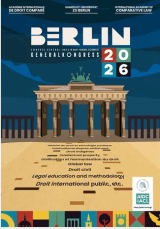
As Gary Bell states, “few cities embody global tensions as vividly as Berlin – a place where the historical divide between West and East meets the contemporary fault lines between global North and South, making it an ideal setting to reflect on law’s role in a divided yet interconnected world…[I]n our dynamic and sometimes even troubled times, the global forum of the General Congress is particularly important.”
As it takes place only every four years, we hope many BACL members will consider taking part, and we look forward to seeing comparative lawyers from the UK and beyond in Berlin in 2026.
For further information and registration, please visit the Congress website: https://iacl.hu-berlin.de
Activities 2025-2026
- Annual Seminar 2025
BACL’s Annual Seminar took place on 2 September 2025, on the occasion of the Society of Legal Scholars’ Conference at the University of Leeds. It was dedicated to ‘Criminal Law in Comparative Perspective’. The event was in person and brought together a good audience for three papers:
- Professor Audrey Guinchard (University of Essex), ‘A Comparative Perspective on the Insanity Defence in French Law: Some Common Fault Lines?’
- Dr Andra Le Roux-Kemp (University of Lincoln), ‘Deportation as Punishment: A Chinese Comparative and Historical Analysis of Deportation Orders in Criminal Sentencing’
- Dr Laurene Soubise (University of Leeds), ‘Judging the Offender: French Criminal Justice Culture and the Challenges of McDonaldization’
- 2026 PGR Workshop at the University of Sussex
The 2026 PGR Workshop took place at the University of Sussex in Brighton. We are much indebted to Dr Sirko Harder for generously hosting it, and to the University of Sussex and Hart Publishing for sponsoring it. Professor Sören Koch of the University of Bergen delivered the keynote address on the topic ‘Living – Let Dying – the Struggle to Regulate Physical Assisted Dying – from a Comparative Perspective’. The Workshop concluded with a talk by Verity Stuart of Hart Publishing on the publication of a PhD thesis with Hart.
The workshop was well attended, with talks on a wide range of comparative law topics. Asian jurisdictions were the subject of much discussion. Presentations were given on the Malaysian constitutional jurisprudence on Fatwa (Zheng Hong See), pathways to citizenship in Hong Kong and Taiwan (Yi-Chen Huang), the right to regulate in international investment law with a focus on Bangladesh, India and Pakistan (Shirin Sultana) and public-private partnerships in Central Asia (Shaimerden Chikanayev).
There were further presentations on comparative public law: nationality-based visas in Chile (Nicolás Rodríguez Rioseco), pharmacy regulation in Great Britain and the US (Denzil Johnson), AI-assisted justice in Germany and Saudi Arabia (Samar Alsayyali), and disability inclusion in Brazil and Germany (Hamanda de Nazaré Freitas Matos).
Comparative private law also featured at the workshop, with presentations on shareholder exit rights in various jurisdictions (Lisa Schűtt), share structures in gig-work platforms (Jiaxing Gao) and contractual hardship in a comparative perspective (Yousuf Al-Balushi).
- Blog posts
The blog featured posts this year on a wide range of topics, ranging, as ever, from original pieces, reflections on recently completed research, to book reviews and summaries of prominent publications. These included pieces by Afroditi Marketou and Joana Mendes on local meanings and what comparative law can offer to EU legal studies; John Bell on comparative law doctorates today; Hannelore Thijs on marriage, property and solidarity in Europe and applying the numerical comparative method in family law;Lucien Carrier on reading lists and legal traditions; Naomi Creutzfeldt on access to justice in an age of digitalisation; Zhiheng (Lily) Lang on tax legality in China as a constitutional principle or governance technique; Ngoc Son Bui, Mara Malagodi, and Christopher Roberts on constitutional structures in Asia; Paula Giliker on comparative law teaching in the UK; and Sören Koch on comparing legal cultures in Europe, and on legislative failure in the regulation of assisted dying.
Paula Giliker’s blog post, based on BACL’s 75th anniversary survey of comparative law teaching, has now been expanded into a full open-access article in The Law Teacher on ‘Teaching comparative law post-Brexit and post-SQE: challenges and choices for UK universities and teachers of comparative law’.
We are also keen to publish short posts from recent PhD graduates, including reflections on comparative law methodology, broader themes arising from recently completed theses, or the wider significance of their research. Please do circulate this message.
Watch this space!
- Annual Seminar 2026
The 2026 Annual Seminar is dedicated to ‘Intellectual Property Law Across Borders: Comparative Perspectives’.
It will take place in person on Wednesday 2 September 2026, from 9:30 to 11:30am on the occasion of the Society of Legal Scholars’ 117th Conference at the University of East Anglia. The seminar will explore how intellectual property law travels across borders, and how comparative analysis can shed light on the harmonisation, divergence and cross-border development of intellectual property law.

Speakers and presentations:
- Professor Estelle Derclaye (University of Nottingham) ‘Dialogue of the deaf? What can we learn from Member States’ court case law in the path to EU copyright harmonisation?’
An analysis of over 1,000 copyright decisions from the 27 Member States and the UK reveals that there is disharmony in the way national courts apply harmonised copyright law. The extent of the disharmony varies per country and per topic. Different reasons explain this state of affairs. This talk will discuss these reasons and highlight especially the differences between countries and groups of countries to show comparative perspectives. It will conclude with reflections on whether the dialogue between the CJEU and national courts is indeed a dialogue of the deaf.
- Dr S. Che Ekaratne (University of Reading) ‘Rights After Death: A Comparison of Post-Mortem Protections of Personal Indicia’
Using recent AI technology, deceased people can be portrayed doing acts they never did while alive. Such portrayals often utilise the deceased’s personal indicia, such as image and voice, and increasingly occur without the consent of their heirs. Legal protections applicable to post-mortem personal indicia differ by jurisdiction. This seminar comparatively analyses two relevant strands of law from different jurisdictions. The first is the law of passing off in England and Wales. While passing off has not yet been applied to post-mortem image and voice, this could be done consistently with current precedent. The second strand, from the United States, derives from rights of publicity and specifically targets unauthorised realistic digital replicas. While both strands have significant limitations, their comparative intersections with other intellectual property laws bring up useful considerations for how best to protect personal indicia after death.
- Professor Ilanah Fhima (University College London) ‘Post-EU Generation? Oatly and its Lessons for the UK and EU’
In February 2026 the UK Supreme Court handed down its decision in Oatly. At issue was whether an application for the trade mark POST-MILK GENERATION for oat drink should be refused as a trade mark because use of the term was prohibited by agricultural regulations. This demonstrates a mismatch between what is required to protect consumers and producers under the EU’s agricultural regime and what is counted as deceptive under trade mark law and has the potential to limit the ability for producers of plant-based alternatives to communicate the nature of their products to consumers. It also presents a puzzle – post-Brexit the UK appears to have locked into stricter compliance with EU agricultural regulations than EU trade mark law requires.
Tea and coffee will be served from 9 am, and there will be time for questions and discussion.
The BACL Committee and speakers will also meet informally for dinner in Norwich on Tuesday 2 September (time and venue tbc) and cordially invite BACL members to join us. Do let the BACL Committee know via britassoccomplaw@gmail.com if you would like to come.
Please register for this event here.
Announcements
- Oxford Comparative Law Discussion Group
The Comparative (private) Law Discussion Group at Oxford’s Faculty of Law has been relaunched. Its convenors, Lionel Smith and Francisco Alvarado Garcia, expect to run a series of lunchtime seminars during 2026-27, generally in hybrid format.
BACL members who wish to join the Group’s mailing list can subscribe by sending a blank email to: comparative-law-discussion-group-subscribe@maillist.ox.ac.uk
Those interested in speaking at the CLDG during 2026-27 should contact Lionel Smith at lionel.smith@law.ox.ac.uk with a proposed title, summary and preferred date(s). Limited funds may be available for travel to Oxford. Although the group is mainly oriented towards in-person presentations, remote presentations may also be considered.Our next Annual Meeting will take place online in December 2026, date tbc.
- BACL also welcomes expressions of interests from reps to organise the PG Workshop in 2027.
- As ever, any suggestions to contribute a blog post or a blog series are gratefully received. Please email your suggestions to britassoccomplaw.blog@gmail.com.britassoccomplaw@gmail.com
- Please do consider following the blog by clicking here. You will then be able to follow all our events and will receive approximatively one email per week during term time about comparative law developments among a wide range of areas of the law. This is an excellent way to provide comparative law illustrations for any modules you might be teaching!
ENJOY THE SUMMER BREAK

